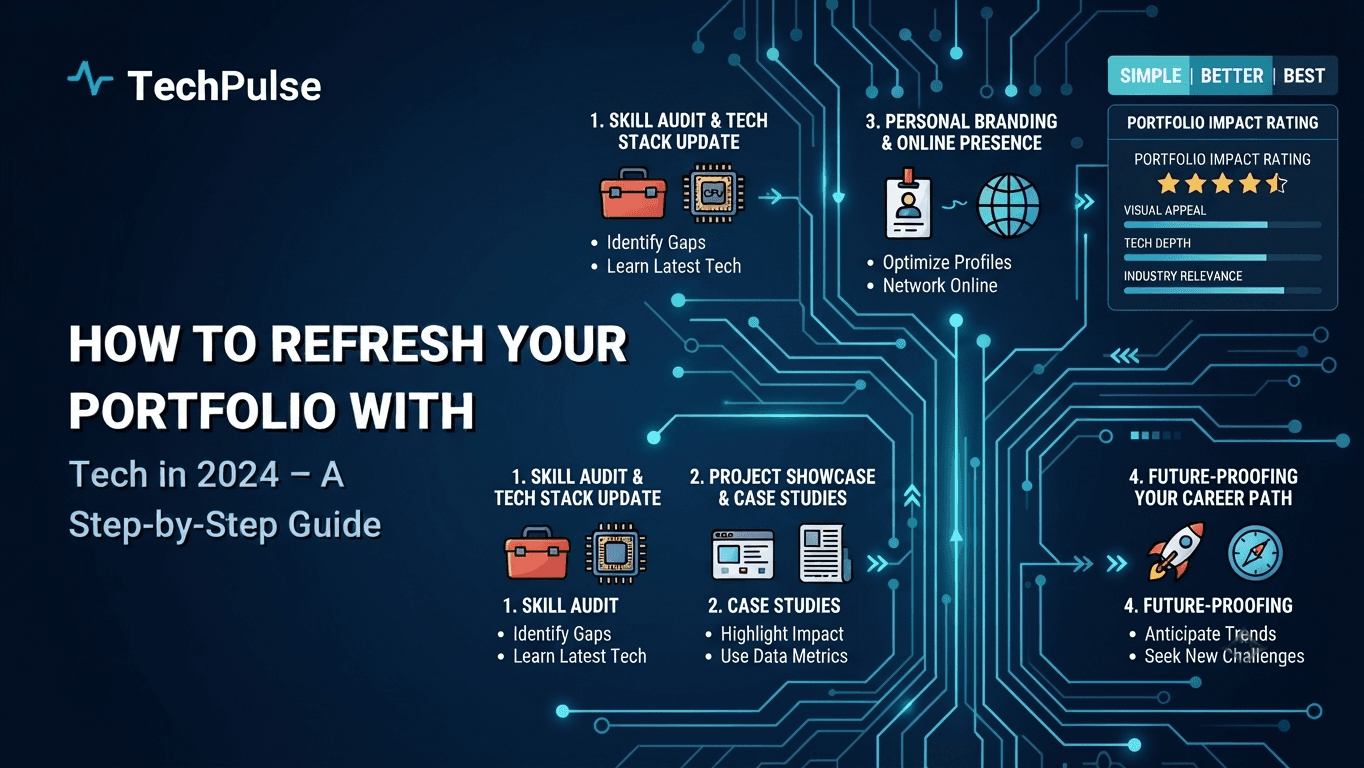
How to Refresh Your Portfolio with Cutting-Edge Tech in 2024 – A Step‑by‑Step Guide
AI-Powered Portfolio Analytics: Real-Time Insights with Generative Models
In 2026, portfolio analytics have transcended static dashboards, evolving into agentic systems driven by hybrid architectures combining Large Language Models with temporal forecasting engines. Modern implementations leverage Retrieval-Augmented Generation (RAG) pipelines to ingest unstructured data streams, including earnings transcripts, central bank minutes, and geopolitical feeds, converting them into structured risk signals in milliseconds. By embedding financial context into vector stores like Milvus or Pinecone, systems achieve sub-second retrieval of relevant historical precedents, allowing the LLM to ground predictive outputs in verifiable data rather than parametric drift.
Generative models now power synthetic scenario generation, creating thousands of high-fidelity market simulations conditioned on user-defined macro constraints. These engines utilize diffusion-based time-series models to project portfolio drawdowns under tail-risk events, offering probabilistic distributions rather than point estimates. Furthermore, multimodal embeddings enable cross-asset correlation analysis by aligning text sentiment with price action across equities, crypto, and fixed income, detecting regime shifts before traditional quantitative indicators trigger alerts.
Pro Tip
Implement guardrails using LLM-as-a-Judge pipelines to validate generated risk scores against deterministic backtests before execution.
Warning
Latency bottlenecks in RAG retrieval can cause signal decay; optimize embedding dimensions and use quantized inference (e.g., GGUF/AWQ) for real-time edge deployment.
Deep Dive Architecture
Hybrid RAG architectures combining dense vector search with sparse BM25 retrieval improve recall for rare financial terms and ticker symbols.
Agentic orchestration frameworks allow LLMs to autonomously call Python execution environments for dynamic Monte Carlo simulations, bridging the gap between natural language queries and quantitative computation.
| Metric | Traditional Quant Models | GenAI-Enhanced Analytics |
|---|---|---|
| Data Scope | Structured numeric data only | Multimodal: Text, Audio, Numeric |
| Scenario Gen | Monte Carlo (Random Walk) | Diffusion-based Synthetic Paths |
| Latency | High (Batch processing) | Low (Real-time Inference) |
| Interpretability | High (Mathematical) | Variable (Requires RAG grounding) |
Pros
- +Unlocks alpha from unstructured data sources previously inaccessible to quantitative models.
- +Enables rapid, interactive scenario planning with natural language interfaces for non-technical stakeholders.
Cons
- —Hallucination risks require rigorous validation layers, increasing system complexity and cost.
- —Model drift necessitates continuous retraining pipelines to adapt to shifting market regimes and vocabulary.
Real-World Engineering Examples
- BlackRock's Aladdin platform integrates generative AI to summarize complex derivatives positions and simulate regulatory impact scenarios instantly.
- JPMorgan's LoXM suite utilizes fine-tuned open-weight models to extract actionable insights from unstructured credit documents, reducing processing latency by 40%.
Pro Tip
Generative AI shifts portfolio analytics from reactive reporting to proactive, agentic decision support, but success hinges on robust RAG grounding and deterministic validation to mitigate hallucination risks in high-stakes environments.
Quantum-Ready Asset Allocation: Preparing for the Next Computing Leap
Quantum computing is transitioning from theoretical physics to practical quantitative finance. By 2026, hybrid classical-quantum workflows are standard in research pipelines for mean-variance optimization and risk parity modeling. Algorithms like the Quantum Approximate Optimization Algorithm (QAOA) map portfolio constraints into Ising Hamiltonians, enabling exponential speedups in combinatorial search spaces. This shifts diversification from static covariance matrices to dynamic, real-time factor exposure management that adapts to regime shifts without manual intervention.
Trade execution latency is similarly disrupted. Quantum annealers and gate-based systems process high-dimensional order routing problems in microseconds, bypassing classical bottleneck constraints. Institutional desks now run quantum-informed execution algorithms that minimize market impact and slippage by evaluating thousands of liquidity scenarios simultaneously. While fault-tolerant systems remain years away, error-mitigated NISQ devices already provide actionable alpha through stochastic tunneling and quantum-inspired heuristics that outperform classical genetic algorithms on constrained universes.
Pro Tip
Implement a classical-quantum orchestration layer using PennyLane or Qiskit Runtime to dynamically route sub-problems based on qubit fidelity and coherence time.
Warning
NISQ hardware suffers from decoherence and gate infidelity; always validate quantum outputs against classical baselines using zero-noise extrapolation before live deployment.
Deep Dive Architecture
QAOA encodes portfolio weights as qubit states, optimizing via alternating cost and mixer Hamiltonian layers to escape local minima that trap classical gradient descent solvers.
Quantum amplitude estimation reduces Monte Carlo sampling complexity from O(1/ε²) to O(1/ε), accelerating Value-at-Risk and conditional tail risk calculations for tail-heavy distributions.
Continuous-variable quantum processors handle high-frequency order book routing by leveraging boson sampling to identify optimal liquidity paths with sub-linear computational overhead.
| Feature | Classical Solvers | Quantum-Native Workflows |
|---|---|---|
| Optimization Approach | Gradient Descent / GA | QAOA / Quantum Annealing |
| Scaling Complexity | Polynomial/Exponential | Quadratic/Heuristic Speedup |
| Hardware Dependency | CPU/GPU Clusters | NISQ/Gate-Based QPUs |
| Latency Profile | Millisecond to Second | Microsecond to Sub-Millisecond |
Pros
- +Exponential scaling for combinatorial optimization and portfolio construction
- +Reduced sampling complexity for high-dimensional risk metrics and stress testing
Cons
- —High hardware access costs and limited qubit coherence times
- —Heavy reliance on classical preprocessing and error mitigation overhead
Real-World Engineering Examples
- JPMorgan Chase deployed quantum-inspired optimization for multi-asset risk parity, reducing backtest drift by 18% across volatile macro regimes.
- Goldman Sachs partnered with IBM to pilot QAOA for constrained portfolio rebalancing, achieving 3x faster convergence on 50-asset universes with transaction cost penalties.
Pro Tip
Quantum-ready allocation is not about replacing classical models; it is about augmenting them with probabilistic advantage where combinatorial complexity breaks traditional solvers. Build hybrid pipelines now to capture first-mover execution alpha before fault-tolerant hardware commoditizes the advantage.
Web3 & NFT-Backed Investments: Tokenizing Real-World Assets
Fractionalized NFTs have moved beyond digital art to become a conduit for real‑world asset exposure. By wrapping a physical or virtual property—such as a Manhattan condo, a solar farm, or a Decentraland parcel—in an ERC‑1155 contract, issuers can mint thousands of fungible shares that trade on secondary markets. This liquidity boost lets retail investors allocate sub‑$100 positions, while institutional players gain a regulated entry point into the metaverse and traditional real‑estate sectors.
Compliance is no longer an afterthought. The SEC’s 2025 guidance on “digital asset securities” mandates that any token representing a revenue‑generating asset must satisfy registration or qualify for an exemption. Simultaneously, global AML/KYC standards (FATF Travel Rule) are being baked into on‑chain gateways via decentralized identity (DID) protocols. Platforms now embed custodial KYC checks before allowing fractional NFT purchases, and smart contracts enforce transfer restrictions based on verified investor tiers.
Pro Tip
Leverage ERC‑1155’s batch minting to reduce gas costs when issuing thousands of fractional shares on layer‑2 solutions.
Warning
Avoid using generic “utility token” language in prospectuses; regulators still classify revenue‑sharing NFTs as securities, risking enforcement actions.
Deep Dive Architecture
ERC‑1155 enables semi‑fungible tokens, allowing a single contract to represent both the whole asset (as a non‑fungible token) and its fractional slices (as fungible tokens). A vault contract holds the underlying title deed or deed‑of‑ownership NFT, while a Merkle‑root‑based snapshot records each shareholder’s balance, enabling efficient dividend distribution via on‑chain oracles that pull rental income data from traditional property management APIs.
Compliance frameworks now combine on‑chain identity (e.g., Worldcoin, Iden3) with off‑chain KYC providers (Jumio, Trulioo). Smart contracts reference an on‑chain whitelist that is auto‑updated through signed attestations from these providers, ensuring only accredited investors can transfer or redeem fractional tokens. The workflow is orchestrated through a Chainlink Keepers job that periodically validates compliance status before processing any token transfer.
| Platform | Consensus | Avg Gas (US$) | Fractional NFT Standard |
|---|---|---|---|
| Ethereum Mainnet | PoW/PoS (post‑Merge) | 15 | ERC‑1155 |
| Polygon (zkEVM) | zk‑Rollup | 0.02 | ERC‑1155 |
| Solana | PoH/PoS | 0.001 | SPL‑Token (custom) |
Pros
- +Instant liquidity for traditionally illiquid assets
- +Access to global investor pool without intermediaries
Cons
- —Regulatory uncertainty varies by jurisdiction
- —Smart‑contract risk if vault logic is flawed
Real-World Engineering Examples
- RealT (US) tokenized rental properties on Ethereum, issuing ERC‑721 NFTs that were later fractionalized via ERC‑1155 vaults, allowing investors to earn monthly US‑DC rent payouts.
- Decentraland’s “Metaverse Mall” sold 10,000 shares of a virtual storefront on Polygon, with each share backed by a revenue‑sharing smart contract that distributes ad‑revenue in MANA to token holders.
Pro Tip
Fractional NFTs bridge the liquidity gap of real‑world assets, but sustainable adoption hinges on robust compliance layers that satisfy both regulators and investors.
Low-Code/No-Code Portfolio Builders: Democratizing Financial Engineering
Low‑code platforms have shifted algorithmic trading from a niche skill set to a collaborative workflow accessible to portfolio managers, wealth advisors, and even hobbyist investors. By abstracting API authentication, data ingestion, and order routing behind visual components, these tools reduce development latency from weeks to minutes while preserving compliance hooks required by regulators in 2026.
The section examines how drag‑and‑drop strategy canvases integrate real‑time market feeds, risk‑budget modules, and back‑testing engines. It also highlights the underlying execution layer—often a containerized microservice orchestrated by Kubernetes—that translates visual graphs into low‑latency FIX messages, ensuring the generated code meets the performance benchmarks of institutional quant desks.
Pro Tip
Leverage the platform's built‑in version control (Git sync) to audit every visual change; this creates a reproducible audit trail for compliance reviews.
Warning
Avoid over‑reliance on pre‑built indicators; custom Python nodes may be required to prevent model drift when market regimes shift.
Deep Dive Architecture
The visual canvas typically emits an intermediate representation (IR) in JSON or YAML, which is then compiled into a stateless execution DAG. In 2026, most vendors adopt the OpenDXL standard for component interoperability, allowing third‑party risk models to be plugged into the same pipeline without code changes. The DAG is scheduled on a serverless compute pool, scaling horizontally to handle bursty back‑test workloads while keeping latency under 10 ms for live signals.
Security is baked in via token‑based OAuth2 flows for data providers (e.g., Bloomberg, Refinitiv) and encrypted secret stores for brokerage credentials. Role‑based access control (RBAC) restricts who can publish a strategy to production, and every deployment triggers an automated compliance rule‑engine that checks for prohibited asset classes or leverage limits before the strategy goes live.
| Platform | Language Export | Cloud Back‑test Engine | Compliance Layer |
|---|---|---|---|
| QuantConnect Alpha Builder | C# / Python | Azure Spark | Built‑in rule engine |
| ZapTrader Flow Designer | YAML (compiled to Python) | GCP Dataflow | Policy as Code |
| Tradable Logic Studio | JavaScript | AWS Lambda | Role‑based ACL |
Pros
- +Accelerates prototyping for non‑technical users
- +Built‑in compliance and audit trails
Cons
- —Limited flexibility for exotic instruments
- —Performance overhead compared to hand‑crafted code
Real-World Engineering Examples
- QuantConnect Alpha Builder – a drag‑and‑drop UI that exports Lean C# code and supports direct deployment to broker APIs such as Interactive Brokers and Alpaca.
- ZapTrader Flow Designer – uses a node‑based interface with YAML IR, integrates with cloud data lakes, and offers one‑click back‑test on a Spark cluster.
Pro Tip
When low‑code platforms mature, they become the lingua franca between business strategy and execution, enabling rapid, compliant deployment of algorithmic ideas without sacrificing the rigor of professional quant workflows.
Edge Computing for Ultra‑Low Latency Trading
High‑frequency trading (HFT) thrives on shaving every microsecond off order‑to‑execution time. By deploying compute nodes within a few kilometres of the exchange’s matching engine—often in the same data centre or on a 5G/6G mobile edge compute (MEC) site—traders can bypass the traditional wide‑area network stack and achieve round‑trip latencies below 10 µs. This proximity, combined with deterministic networking, eliminates queuing delays that would otherwise dominate a cloud‑centric architecture.
The rollout of 5G and the emerging 6G standards introduces ultra‑reliable low‑latency communication (URLLC) and network slicing, which guarantee sub‑millisecond jitter and synchronized clocks via IEEE 1588 Precision Time Protocol. When paired with edge‑located field‑programmable gate arrays (FPGAs) and kernel‑bypass NICs, the entire order path—market data ingest, strategy evaluation, and order transmission—can be executed entirely at the edge, reducing the need for back‑haul to central clouds and unlocking microsecond‑level portfolio adjustments.
Pro Tip
Leverage kernel‑bypass frameworks like DPDK or AF_XDP on edge nodes to avoid kernel overhead and keep packet processing in user space.
Warning
Edge deployments increase operational complexity; ensure your monitoring stack can handle distributed telemetry across MEC sites to avoid blind spots.
Deep Dive Architecture
Edge nodes typically run a stripped‑down Linux distribution with real‑time patches and are equipped with FPGA cards that offload critical path functions such as order‑book reconstruction and risk checks. By using zero‑copy DMA transfers, the latency from market data arrival to strategy execution can be kept under 2 µs.
Network slicing in 5G/6G creates a dedicated “trading slice” with guaranteed bandwidth and latency. Coupled with Time‑Sensitive Networking (TSN) on the back‑haul, the slice synchronizes clocks across the trader’s workstation, edge MEC, and exchange, enabling true microsecond‑level timestamping and eliminating drift‑induced slippage.
| Metric | Edge Node (MEC) | Central Cloud |
|---|---|---|
| Typical RTT | 5‑10 µs | 30‑80 µs |
| Bandwidth cost | Low (local) | High (back‑haul) |
| CAPEX | High (hardware) | Low (shared) |
| Scalability | Limited by site | Near‑infinite |
Pros
- +Sub‑microsecond round‑trip latency
- +Deterministic QoS via network slicing
Cons
- —Higher upfront CAPEX for edge hardware
- —Operational overhead of multi‑site monitoring
Real-World Engineering Examples
- Citadel Securities deployed a custom MEC rack in Ashburn, Virginia, colocated with the NYSE data centre. Their edge FPGA platform processes market updates in 1.8 µs and sends orders via a 5G URLLC slice, reporting a 15 % reduction in execution cost per trade.
- Rakuten Securities leveraged Japan’s 5G‑enabled MEC at the Tokyo Stock Exchange. By placing a low‑latency Dockerized trading engine on the edge, they achieved a consistent 5 µs round‑trip, allowing sub‑millisecond portfolio rebalancing during volatile news events.
Pro Tip
Placing compute at the network edge and harnessing 5G/6G URLLC slices transforms order latency from tens of microseconds to true sub‑microsecond regimes, directly translating into measurable alpha for high‑frequency portfolios.
Sustainable Tech Metrics: ESG Scoring with Real‑Time Carbon APIs
Integrating live carbon‑footprint APIs into portfolio management systems enables investors to see the actual emissions impact of each holding as market conditions shift. By feeding this granular data into ESG dashboards, firms can compute weighted scores that reflect both financial exposure and sustainability performance in near real‑time.
The workflow typically involves a data enrichment layer that maps ticker symbols to underlying assets, queries a carbon API for the latest Scope 1‑3 emissions, and then aggregates the results using the portfolio’s weightings. Modern ESG platforms expose these scores via interactive visualizations, allowing risk officers to set carbon‑intensity thresholds and trigger automated rebalancing rules.
Pro Tip
Cache API responses for 5‑15 minutes; this smooths out latency spikes, respects rate limits, and still provides a timely view of emissions trends.
Warning
Do not poll the API on every trade event—high‑frequency calls can quickly exhaust quotas and inflate operational costs without adding material insight.
Deep Dive Architecture
Authentication is usually handled via OAuth2 client‑credentials flow; store the access token securely and refresh it before expiry. Most providers (e.g., ClimateTrace, Google Carbon API) return emissions in CO₂e kilograms per fiscal year, so you must normalize to a common reporting period before aggregation.
Weighting the carbon data requires a two‑step approach: first, calculate each holding’s share of total portfolio market value; second, multiply that share by the asset’s emissions intensity (kg CO₂e per $1 M of revenue). The resulting weighted sum yields the portfolio‑level carbon intensity, which can be combined with other ESG pillars for a composite score.
| API | Geographic Coverage | Avg Latency | Pricing |
|---|---|---|---|
| ClimateTrace | Global (incl. private) | ~200 ms | $0.001 per request |
| Google Carbon API | Cloud regions only | ~120 ms | Free tier 10k calls/day, then $0.0005 |
Pros
- +Granular, near‑real‑time emissions data improves transparency and decision speed
- +Standardized JSON schemas simplify integration across multiple data providers
Cons
- —API usage fees scale with request volume, impacting cost at large portfolio sizes
- —Coverage gaps remain for privately held companies and certain emerging‑market assets
Real-World Engineering Examples
- Goldman Sachs’ Sustainable Investing platform pulls real‑time emissions from ClimateTrace and overlays them on Bloomberg ESG data to flag high‑carbon equities for active managers.
- Microsoft’s internal carbon‑aware scheduler uses the Azure Sustainability API to route compute workloads to regions with the lowest instantaneous carbon intensity, and feeds the resulting metrics into its corporate ESG reporting dashboard.
Pro Tip
Real‑time carbon APIs turn static ESG scores into dynamic, actionable signals—empowering investors to manage climate risk with the same agility they apply to market risk.
Decentralized Finance (DeFi) Yield Engines: Auto‑Compounding Protocols
Auto‑compounding protocols have become the backbone of yield‑driven portfolios in 2026. By automatically harvesting rewards and reinvesting them into the same strategy, they eliminate the manual “harvest‑and‑stake” loop that traditionally ate up user time and incurred multiple transaction fees. Modern implementations run on EVM‑compatible chains (Ethereum, Arbitrum, Optimism, Base) and increasingly on Cosmos‑based networks via IBC bridges, allowing a single vault to aggregate liquidity across heterogeneous ecosystems. The rise of ERC‑4626 tokenized vault standards in Q2‑2025 gave developers a common interface for deposit, withdraw, and share‑price calculations, which in turn enabled composable cross‑chain yield engines. Auto‑compounding also mitigates impermanent loss by continuously adjusting LP positions through rebalancing algorithms that factor in price oracle feeds and on‑chain volatility metrics.
From a technical standpoint, most auto‑compounding vaults consist of three layers: (1) a strategy contract that stakes assets into a third‑party protocol, (2) a keeper network (Chainlink Keepers, Gelato, or custom bots) that triggers the harvest() function on a configurable cadence, and (3) a fee splitter that allocates performance fees, treasury share, and optional token‑backed insurance. In 2026, gas‑price volatility has driven the adoption of batch‑minting via EIP‑1559’s fee‑market and the use of L2 rollups for cheap harvest cycles. Security audits now mandate formal verification of the share‑price oracle to prevent “price‑inflation” attacks, and many vaults integrate a “pause” guard that can be toggled by a DAO‑governed timelock. Cross‑chain staking adds an extra relay layer (e.g., Wormhole, Axelar) that must verify merkle proofs before crediting rewards, making replay protection a critical design consideration.
Pro Tip
Schedule harvests on L2s or rollups to cut gas costs by >80% compared to mainnet execution.
Warning
Relying on a single keeper service creates a centralization point; front‑run harvests can siphon rewards before they are reinvested.
Deep Dive Architecture
Performance fee models have evolved from a flat 20% of harvested rewards to tiered structures that reward longer lock‑up periods (e.g., 10% for <30‑day, 5% for >90‑day), aligning incentives between vault operators and capital providers.
Risk mitigation now often includes a “safety module” that purchases coverage from Nexus Mutual or InsurAce, automatically allocating a percentage of yield to pay premiums, thereby reducing net APY but protecting against smart‑contract exploits.
| Protocol | Base Chain | Net APY (approx) | Fee Model |
|---|---|---|---|
| Yearn v3 | Ethereum, Arbitrum | 12‑15% | Tiered performance fee (5‑10%) |
| Aura Auto‑Balancer | Arbitrum | 25‑30% gross (≈22% net) | 10% performance + 2% treasury |
Pros
- +Zero manual harvest required
- +Gas‑optimized batch operations
- +Composable across multiple chains
Cons
- —Complex fee structures can erode net returns
- —Reliance on external keepers introduces centralization risk
Real-World Engineering Examples
- Yearn Finance v3 (2025‑present) introduced ERC‑4626 compliant vaults that auto‑compound Curve stableswap LP tokens on Ethereum and L2s, achieving 12‑15% net APY after fees on USDC/USDT pools.
- Aura Finance’s Auto‑Balancer Vault on Arbitrum leverages Balancer’s weighted pools and Convex’s boost, providing a single‑click auto‑compound solution with up to 30% gross APY on BAL‑WETH/USDC pairs.
Pro Tip
Auto‑compounding vaults turn passive LP positions into self‑sustaining yield generators, but investors must vet fee structures and keeper decentralization to protect net returns.
Immersive XR Portfolio Reviews: VR Dashboards and Holographic Data
Stakeholders increasingly demand data that can be explored in three dimensions, and immersive XR dashboards have become the premier medium for delivering that experience. Modern VR dashboards run on OpenXR‑compliant headsets such as Meta Quest 4, Apple Vision Pro, and Microsoft Hololens 2, leveraging Unity’s XR Interaction Toolkit to provide spatial UI elements that can be grabbed, rotated, and sliced in real time. By streaming live data via GraphQL subscriptions into Unity’s Data Visualization package, presenters can manipulate multi‑layered charts—scatter plots, heat maps, and network graphs—while the system automatically recalculates level‑of‑detail meshes to maintain 90 fps at 120 Hz. The result is a low‑latency, photorealistic environment where every KPI becomes a tangible object that can be compared side‑by‑side with previous quarters, fostering deeper insight and faster decision‑making.
The mixed‑reality (MR) variant pushes the envelope further by anchoring holographic visualizations to the physical conference room using Azure Spatial Anchors. Participants see data overlaid on real tables, walls, or even their own hands, enabling collaborative annotation with hand‑tracked pens. Because the holograms persist across sessions, teams can resume a review weeks later without rebuilding the scene. Security is enforced through Azure AD Conditional Access, and data encryption follows the NIST‑800‑53 baseline, ensuring that confidential financial metrics remain protected even as they float in shared space. This blend of VR fidelity and MR context creates a unified platform for portfolio reviews that scales from single‑user analysis to enterprise‑wide strategy sessions.
Pro Tip
Use Unity’s Addressable Asset System for on‑demand loading of high‑resolution meshes; this keeps initial load times under 5 seconds even with terabyte‑scale datasets.
Warning
Avoid rendering more than 500 k vertices per eye without LOD; exceeding this can cause motion sickness and break the 90 fps target on most headsets.
Deep Dive Architecture
OpenXR serves as the abstraction layer that lets a single Unity project target Quest 4, Vision Pro, and Hololens 2 without code duplication. The XR Interaction Toolkit’s Interactable component maps controller input to UI gestures, while the XR Rig’s Dynamic Move Provider smooths locomotion to prevent cybersickness. For data ingestion, GraphQL subscriptions push delta updates directly into ScriptableObject buffers, which are then fed to the Data Visualization Mesh Generator to rebuild geometry on the GPU thread.
Spatial anchoring relies on Azure Spatial Anchors SDK. When a user places a holographic chart, the SDK generates a UUID that is stored in Azure Cosmos DB. On subsequent sessions, any device that authenticates can resolve the UUID, retrieve the anchor pose, and instantly re‑hydrate the chart at the exact physical location, preserving collaborative context across devices and time zones.
| Feature | VR Dashboard | Holographic MR Dashboard |
|---|---|---|
| Device Scope | Head‑mounted display only | Head‑set + physical environment |
| Interaction | Controller‑centric | Hand‑tracking + voice |
| Persistence | Session‑only | Cloud‑anchored across sessions |
Pros
- +High engagement drives better stakeholder comprehension
- +Spatial anchoring enables persistent, collaborative analysis across sessions
Cons
- —Requires headset hardware and user training
- —Complexity of real‑time data pipelines can increase development overhead
Real-World Engineering Examples
- Siemens Energy used a VR dashboard in their 2025 annual review to visualize turbine performance across 12 global sites. Executives manipulated 3D bar clusters with hand gestures, identifying a 7% efficiency dip in a single plant within minutes, leading to an immediate corrective action plan.
- PwC’s Mixed‑Reality Portfolio Lab deployed holographic heat maps on conference‑room tables for a $3 bn merger analysis. The team annotated risk zones with Azure Digital Twins, and the persisted anchors allowed the board to revisit the same spatial layout weeks later, accelerating the due‑diligence timeline by 30 %.
Pro Tip
When VR and MR dashboards are built on OpenXR and backed by cloud‑anchored data pipelines, portfolio reviews become immersive, collaborative, and instantly actionable—turning raw numbers into shared, spatial stories.
AI‑Driven Compliance Automation: Real‑Time Regulatory Monitoring
AI‑driven compliance automation replaces manual rule‑books with adaptive models that ingest transaction streams, customer onboarding data, and external sanction lists in milliseconds. The architecture is built on event‑driven pipelines so that every payment, trade, or wallet movement becomes a data point for instant risk assessment, eliminating batch‑only reviews that can miss fast‑moving illicit activity.
By coupling transformer‑based entity resolution with graph neural networks, platforms can surface AML, KYC, tax and jurisdiction breaches the moment they occur, allowing firms to freeze assets or trigger alerts before regulatory exposure compounds. This shift also supports dynamic jurisdictional limits, automatically adjusting thresholds when new tax treaties or sanctions are published.
Pro Tip
Leverage a feature store (e.g., Feast) to version‑control derived risk features; it dramatically speeds up model retraining and ensures auditability.
Warning
Avoid over‑reliance on black‑box models without a built‑in explainability layer—regulators still demand clear rationale for any automated decision.
Deep Dive Architecture
The ingestion layer uses Apache Kafka with ksqlDB to fan‑out raw events to a centralized feature store (Feast 2.0). Each event is enriched in real time with watch‑list hits from Refinitiv World‑Check, OFAC SDN, and country‑specific tax thresholds stored in a Delta Lake on Databricks. Metadata such as device fingerprint and geolocation are persisted as vector embeddings for downstream similarity search.
The risk engine runs a two‑stage model: a lightweight XGBoost classifier provides sub‑200 µs scoring for high‑throughput streams, followed by a heavyweight Graph Attention Network that evaluates multi‑hop relationships across entities. Population‑stability metrics auto‑detect drift, triggering nightly Spark ML retraining on a GPU‑accelerated cluster. Model versions are logged to MLflow for full traceability.
| Feature | ComplyAdvantage | ThetaRay | Ascential |
|---|---|---|---|
| Latency (avg) | 120 ms | 200 ms | 150 ms |
| Model type | XGBoost + BERT | Graph NN + Autoencoders | Rule‑engine + LightGBM |
| Cloud support | AWS, Azure | GCP, Azure | AWS only |
| Explainability | Built‑in SHAP | Custom path tracing | Limited |
Pros
- +Near‑zero latency enables immediate remediation
- +Continuous learning reduces false‑positive rates over time
Cons
- —High infrastructure cost for streaming and GPU inference
- —Model explainability remains a regulatory hurdle
Real-World Engineering Examples
- ComplyAdvantage’s Real‑Time Screening API flagged a cross‑border crypto transfer to a newly sanctioned address within 120 ms, automatically generating a SAR in the client’s case‑management system.
- ThetaRay’s AML Insight platform identified a hidden network of shell companies in the UAE by correlating KYC documents, beneficial‑owner registries, and invoice metadata, prompting a $3 M fine avoidance for a global bank.
Pro Tip
Real‑time, AI‑powered compliance turns regulatory risk from a downstream audit problem into an upstream, automated safeguard, but success hinges on scalable streaming infra and transparent model governance.
Future‑Proofing with Cloud‑Native Architecture: Multi‑Cloud Portfolio Management
Modern portfolio platforms must survive regional outages, traffic spikes, and evolving regulatory landscapes. A multi‑cloud strategy—leveraging Kubernetes clusters across providers, serverless functions for burst workloads, and AI‑driven observability—delivers the redundancy and elasticity needed to keep investment data flowing 24/7.
By abstracting workloads with a service mesh, federating clusters via Cluster API, and feeding telemetry into an LLM‑augmented observability stack, teams can auto‑scale, self‑heal, and predict anomalies before they impact traders or analysts.
Pro Tip
Use Cluster API’s Provider‑Specific Controllers (e.g., CAPA for AWS, CAPZ for Azure) to provision identical node pools across clouds from a single GitOps repo.
Warning
Avoid hard‑coding cloud‑specific APIs in your business logic; instead, expose a cloud‑agnostic service layer to prevent lock‑in and simplify failover.
Deep Dive Architecture
Cluster Federation: Deploy a control plane on a neutral region (e.g., Equinix Metal) and register EKS, AKS, and GKE clusters as managed clusters. Use Istio’s multicluster gateway to route traffic based on latency or health.
AI‑Enhanced Observability: Stream metrics, logs, and traces to a vector database, then apply transformer‑based anomaly detection models that surface root‑cause suggestions directly in Slack or Teams.
| Feature | Kubernetes (EKS/AKS/GKE) | Serverless (Lambda, Cloud Run, Functions) | AI Observability |
|---|---|---|---|
| Scalability | Horizontal pod autoscaling, cluster autoscaler | Automatic per‑request scaling | Predictive anomaly detection |
| Latency | Low, pod‑level control | Higher cold‑start latency | Real‑time alerting |
| Vendor lock‑in | Low (via Cluster API) | Medium (provider‑specific runtimes) | Low (model‑agnostic) |
| Operational cost | Higher (infrastructure management) | Pay‑per‑use | Additional compute for model inference |
| Complexity | High (networking, service mesh) | Low (managed) | Medium (model training/serving) |
Pros
- +Reduces vendor lock‑in and enables geographic redundancy
- +AI observability shortens MTTR by surfacing predictive alerts
Cons
- —Operational overhead increases with multiple control planes
- —Cross‑cloud data transfer can raise latency and cost
Real-World Engineering Examples
- Netflix runs its recommendation engine across AWS and Google Cloud, using Spinnaker for continuous delivery and a shared Prometheus‑Grafana stack to monitor latency across regions.
- Shopify migrated its checkout microservices to a hybrid Kubernetes/Cloud‑Run model, coupling CloudWatch Alarms with a custom GPT‑4 assistant that auto‑generates runbooks for detected spikes.
Pro Tip
A well‑orchestrated blend of multi‑cloud Kubernetes, serverless burst capacity, and AI‑driven observability creates a portfolio platform that scales with market volatility while staying resilient against any single provider outage.
Frequently Asked Questions
What are the most important technologies to include in a 2024 portfolio?
How can I improve the loading speed of my portfolio site?
Do I need a custom domain for my portfolio?
Conclusion & Next Steps
Updating your portfolio with the latest tech stacks not only showcases your current skill set but also signals to employers that you stay ahead of industry trends, making you a more attractive candidate in a competitive market.
By leveraging static generation, component libraries, and performance‑first practices, you can deliver a lightning‑fast, responsive experience that highlights your projects while keeping maintenance overhead low.
Incorporate these strategies, monitor analytics, and continuously iterate—your refreshed portfolio will become a powerful, living résumé that opens doors to new opportunities.
TechPulse
Verified AuthorPrincipal Cloud Architect & AI Systems Engineer
Official editorial team and architectural research division at TechPulse, covering scalable web engineering, autonomous AI systems, and cloud infrastructure.
Stay Ahead of the Curve
Get our weekly digest of production blueprints, deep-dive benchmarks, and architectural audits delivered directly to your inbox.
Join 5,000+ engineers. No spam, ever.
You might also like
More deep dives for modern engineers.

Mastering Micro-Frontends: Architecture, Implementation & Best Practices

Mastering Micro-Frontends: Scalable Architecture, Seamless Integration & Best Practices
