Mastering Micro-Frontends: Scalable Architecture, Seamless Integration & Best Practices
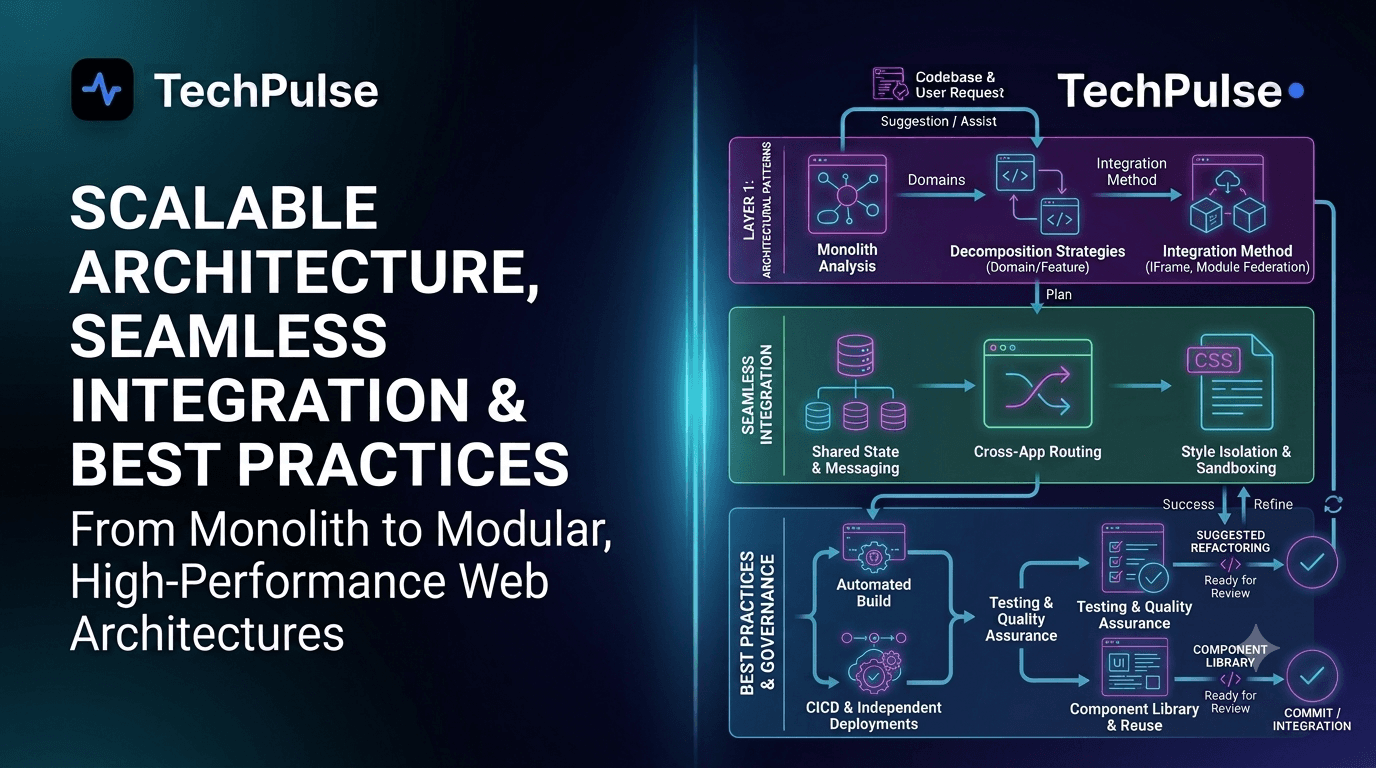
Evolution of Micro-Frontends in 2026: Market Landscape
The year 2026 marks a watershed moment for micro‑frontends, transitioning from a niche architectural curiosity to a mainstream solution for large‑scale digital products. Enterprises that once hesitated due to perceived operational overhead now report measurable reductions in release cycle latency—often shaving weeks off a quarterly roadmap. This shift is driven by a confluence of factors: the maturation of module federation standards, the rise of composable commerce platforms, and a talent market that rewards teams capable of delivering isolated UI slices without compromising brand cohesion.
Industry demand has been amplified by the explosion of headless commerce and omnichannel experiences. Brands are no longer confined to a single web portal; they must orchestrate mobile web, progressive web apps, and native shells from a unified codebase. Micro‑frontends provide the granularity needed to ship feature‑specific bundles to distinct channels while preserving a single source of truth for shared design tokens and API contracts. As a result, adoption rates among Fortune 500 companies have surged from 12% in 2023 to an estimated 38% in 2026.
Ecosystem shifts have also played a pivotal role. The open‑source community has converged around a handful of interoperable runtimes—Webpack Module Federation, Vite's federation plugin, and the emerging Federation 2.0 spec—creating a de‑facto standard that reduces vendor lock‑in. Cloud providers now offer first‑class support for distributed UI assets via edge‑caching CDNs, enabling sub‑millisecond load times for federated modules regardless of geographic location. This infrastructure evolution addresses the latency concerns that previously hampered large‑scale rollouts.
From a governance perspective, organizations are adopting a "domain‑driven UI" model, mirroring the success of domain‑driven design in backend micro‑services. Product squads own end‑to‑end feature slices, from data fetching hooks to UI components, and publish them as versioned federated modules. Centralized observability platforms now ingest runtime metrics—such as module load failures and bundle size drift—allowing engineering leadership to enforce compliance without stifling autonomy. The net effect is a healthier balance between speed, stability, and scalability.
Pro Tip
Leverage a shared design‑token library published via a private npm scope; this ensures visual consistency across independently deployed micro‑frontend slices.
Warning
Avoid over‑fragmentation: too many tiny federated modules can inflate network chatter and complicate version management, leading to cache‑busting cascades.
Deep Dive Architecture
Runtime module resolution via Webpack's `container` and `remote` entry points.
Dynamic import fallback strategies for offline or degraded network conditions.
Version negotiation protocol embedded in the federation manifest to prevent breaking changes.
Edge‑cache invalidation rules based on semantic versioning tags.
Telemetry hooks injected by the federation runtime to capture load latency and error rates.
| Aspect | Monolith UI | Micro‑services Backend | Micro‑Frontends |
|---|---|---|---|
| Deployment Frequency | Low | Medium | High |
| Team Autonomy | Low | High | High |
| Runtime Overhead | Minimal | Moderate | Moderate |
| UI Consistency | High | N/A | Dependent on governance |
| Learning Curve | Low | Medium | High |
Pros
- +Independent deployment reduces coordination overhead.
- +Team autonomy aligns with domain‑driven product ownership.
- +Improved scalability through selective bundle loading.
Cons
- —Increased complexity in build and runtime orchestration.
- —Potential for UI inconsistency without strict design governance.
- —Higher initial learning curve for developers unfamiliar with federation.
Real-World Engineering Examples
- A global retailer migrated its checkout flow to a set of three micro‑frontends—cart, payment, and confirmation—reducing release friction from monthly to weekly.
- A SaaS platform uses micro‑frontends to serve customized dashboards per client, allowing each account team to ship UI updates without affecting others.
- An online media company adopted micro‑frontends for its video player, enabling rapid A/B testing of UI overlays while keeping the core playback engine stable.
Pro Tip
In 2026, micro‑frontends have matured into a production‑ready paradigm that delivers rapid, autonomous releases while preserving brand cohesion—provided organizations invest in standardization, performance tooling, and disciplined governance.
Key Drivers Behind 2026 Adoption
1. Standardization – The Module Federation 2.0 specification, ratified by the OpenJS Foundation, provides a stable contract for runtime module sharing, reducing integration risk.
2. Performance at the Edge – CDNs now support on‑the‑fly module stitching, eliminating the need for a central orchestration server and cutting TTFB by up to 45%.
3. Talent Alignment – Modern front‑end engineers are fluent in React, Vue, and Svelte; micro‑frontend frameworks let them stay within their preferred stack while contributing to a larger product.
Core Architectural Patterns: Module Federation, Web Components, and Edge‑Driven Composition
Module Federation, introduced in Webpack 5, treats each frontend slice as a remote container that can expose and consume modules at runtime. The host application dynamically loads JavaScript bundles from peers, allowing independent versioning and isolated builds while preserving a shared runtime for React, Angular, or Vue. This model excels when teams own distinct feature areas, need hot‑module replacement across codebases, and can afford a small runtime overhead for the federation runtime. Critical to its success is a well‑defined shared‑dependency manifest and a deterministic chunk naming strategy to avoid cache‑busting surprises.
Web Components provide a standards‑based, framework‑agnostic encapsulation primitive using Custom Elements, Shadow DOM, and HTML templates. By publishing a component as a self‑contained bundle (often via ES modules or a CDN), any host can import and render it without coupling to the host's framework. This approach shines in heterogeneous environments where legacy and modern stacks coexist, or when a design system must be shared across multiple product lines. The trade‑off is that orchestration, state sharing, and routing must be handled manually, which can increase boilerplate in large ecosystems.
Edge‑Driven Composition pushes the assembly point to the CDN or edge layer, stitching together HTML fragments, CSS, and JavaScript at request time. Using technologies like Cloudflare Workers, Fastly Compute@Edge, or Vercel Edge Functions, the edge server resolves a manifest of feature modules and streams a composite response to the client. This pattern reduces first‑byte latency, enables geo‑aware version rollouts, and decouples deployment cycles entirely from the client. However, it introduces complexity in cache invalidation, requires strict CSP compliance, and demands that each fragment be side‑effect free.
Choosing the right model hinges on three axes: team autonomy, performance constraints, and ecosystem heterogeneity. Module Federation is optimal when you have multiple SPAs sharing a common runtime and need fine‑grained version control. Web Components win when you must support diverse frameworks or legacy browsers with a single reusable UI token. Edge‑Driven Composition is the answer for ultra‑low latency, globally distributed apps where the cost of an extra network hop is offset by the ability to serve the freshest UI without a full page reload. Align the pattern with your organization’s release cadence and operational maturity to avoid over‑engineering.
Pro Tip
Leverage shared dependency version ranges in Module Federation to prevent duplicate React instances, which can cause hook errors.
Warning
Avoid loading Web Components that manipulate global CSS variables without isolation; they can unintentionally bleed styles into the host page.
Deep Dive Architecture
Runtime loader in Module Federation resolves remoteEntry.js via a global __webpack_init_sharing__ call
Shadow DOM creates a separate CSS cascade, preventing style leakage
Edge workers must serialize and deserialize HTML fragments efficiently to stay within CPU limits
Each pattern requires a distinct CI/CD pipeline: federated builds, component packaging, or edge manifest generation
State synchronization across fragments often relies on a lightweight event bus or shared storage like IndexedDB
| Pattern | Runtime Composition | Build‑time Integration | Browser Support | Team Autonomy |
|---|---|---|---|---|
| Module Federation | Yes | Yes (Webpack) | Modern browsers (ESM) | High |
| Web Components | No (static import) | No (standard) | All modern + polyfills | Medium |
| Edge‑Driven Composition | Yes (edge) | No (manifest) | Any (HTML) | Highest |
Pros
- +Independent deployment cycles
- +Framework agnostic UI tokens
- +Reduced latency via edge stitching
Cons
- —Runtime overhead for federation
- —Manual state management for web components
- —Complex cache invalidation on the edge
Real-World Engineering Examples
- Spotify’s "Playback" UI uses Module Federation to let the music player and recommendation carousel evolve independently
- Salesforce Lightning Web Components are built on the Web Components spec, enabling cross‑org component reuse
- Shopify’s storefront leverages Edge‑Driven Composition to assemble personalized product sections at the CDN edge
Pro Tip
Select Module Federation for fine‑grained runtime sharing, Web Components for framework‑agnostic reuse, and Edge‑Driven Composition when ultra‑low latency and global distribution outweigh added operational complexity.
Choosing the Right Composition Model
Start by mapping each product team’s release cadence to the composition latency budget. If teams ship daily and share a monorepo, Module Federation’s runtime stitching offers the most flexibility. If you need a single source of truth for UI across mobile web, desktop, and internal tools, encapsulate the UI as Web Components and publish them to a private npm registry or CDN. For consumer‑facing portals where milliseconds matter, evaluate Edge‑Driven Composition and prototype a manifest‑driven worker that assembles fragments on the fly.
Top Frameworks & Toolchains: Next.js 14, Vite, Turborepo, Nx, Qwik, and Astro
Micro‑frontends demand a delicate balance between independent deployment, shared UI standards, and fast iteration cycles. Next.js 14 brings the App Router, Server Components, and built‑in edge runtime, making it a heavyweight for teams that already live in the React ecosystem and need zero‑config SSR while still supporting module‑federation‑style remotes via the new `nextjs-mf` plugin. Vite, on the other hand, is a dev‑server‑first bundler that shines with lightning‑quick HMR and native ES‑module imports, allowing each micro‑frontend to be authored in vanilla JS, React, Vue, or Svelte without heavyweight abstraction. Turborepo and Nx provide the monorepo scaffolding that ties these disparate builds together, offering caching, task pipelines, and dependency graph awareness that keep CI times low even as the number of remote packages grows. Qwik and Astro focus on delivering ultra‑lightweight islands of interactivity; Qwik’s resumability and Astro’s component‑level partial hydration make them ideal for performance‑critical edge deployments where each micro‑frontend should ship only the code it actually uses.
When evaluating these tools, consider both the developer experience and the runtime footprint. Vite’s plugin ecosystem (e.g., `vite-plugin-federation`) enables true runtime federation without a custom server, but it lacks the opinionated routing and data‑fetching layers that Next.js provides out‑of‑the‑box. Turborepo excels at orchestrating builds across heterogeneous tech stacks, yet its default remote caching requires a paid Vercel or self‑hosted storage layer for large teams. Nx adds powerful code‑generation schematics and affected‑project detection, but its steep learning curve can slow onboarding. Qwik’s compile‑time optimizer produces minuscule bundles, but debugging resumable code can be non‑intuitive. Astro’s “content‑first” model encourages static rendering, yet integrating complex stateful micro‑frontends may require extra adapters. The sweet spot often emerges from a hybrid approach: host a Next.js shell, pull in Vite‑built remote widgets, and manage the whole repo with Nx for fine‑grained caching.
The practical outcome is a stack where each micro‑frontend chooses the framework that best matches its functional requirements while the monorepo tooling guarantees consistent versioning, shared ESLint/Prettier configs, and incremental builds. This modularity reduces cognitive load, accelerates CI, and keeps the end‑user payload under control, which is the core promise of micro‑frontend architecture.
Pro Tip
Leverage Nx’s `run-many` command with the `--parallel` flag to build Vite and Next.js remotes concurrently; the built‑in distributed caching will skip unchanged packages entirely.
Warning
Avoid mixing multiple monorepo tools (e.g., Turborepo and Nx) in the same repo—conflicting cache directories can cause nondeterministic builds and wasted storage.
Deep Dive Architecture
Nx’s Project Graph parses `package.json` and `tsconfig` to compute precise affected scopes, enabling targeted rebuilds of only those micro‑frontends that import a changed UI component.
Vite’s native ES‑module dev server eliminates the need for a separate bundling step during development, which reduces memory overhead when running dozens of micro‑frontend dev instances simultaneously.
Next.js 14’s Edge Runtime executes JavaScript at the CDN edge, allowing micro‑frontend composition to happen before the request reaches the origin server, dramatically lowering TTFB for federated pages.
Turborepo’s Remote Caching stores artifact hashes in an S3 bucket; when a remote widget’s source hasn’t changed, downstream builds retrieve the cached bundle instantly, shaving minutes off CI pipelines.
Qwik’s resumability compiles components into lazy‑loaded chunks that rehydrate only on interaction, ensuring that a micro‑frontend’s initial load never exceeds the size of its static HTML.
| Framework/Tool | Supports MF | Build Speed | TypeScript | Monorepo Friendly |
|---|---|---|---|---|
| Next.js 14 | Yes | Medium | Yes | Yes (via Turborepo/Nx) |
| Vite | Yes | Fast | Yes | Yes (via Turborepo/Nx) |
| Turborepo | N/A | Fast (caching) | Yes | Yes |
| Nx | N/A | Fast (caching) | Yes | Yes |
| Qwik | Yes | Medium | Yes | Yes (via Nx) |
| Astro | Yes | Fast | Yes | Yes (via Nx) |
Pros
- +Unified monorepo tooling reduces version drift
- +Framework‑specific strengths (SSR, resumability, HMR) can be leveraged per domain
- +Incremental caching cuts CI time dramatically
Cons
- —Increased architectural complexity requires disciplined governance
- —Tooling mismatches can surface when mixing SSR and edge‑only builds
- —Learning curve for advanced Nx/Turborepo pipelines is steep
Real-World Engineering Examples
- Spotify’s web player uses a Next.js shell to serve the main navigation while loading Vite‑built React widgets for personalized playlists and recommendations.
- Shopify’s Hydrogen storefronts combine Astro for static product pages with Qwik‑based checkout widgets to achieve sub‑500 ms First Contentful Paint across global edge nodes.
- Netflix’s internal admin dashboard aggregates dozens of Nx‑managed micro‑frontends, each built with Vite, allowing teams to ship UI changes every sprint without breaking the monorepo CI pipeline.
Pro Tip
Pick the framework that solves the specific performance or developer‑experience problem for each domain, and let Nx or Turborepo orchestrate the builds—this combination delivers the scalability and speed micro‑frontends promise without sacrificing maintainability.
Choosing the Right Stack
Start by mapping business domains to technical domains: high‑traffic public pages often benefit from Next.js’s edge rendering, whereas internal dashboards can be powered by Vite‑based React or Vue widgets for rapid iteration. Next, assess shared UI libraries—if you have a design system in TypeScript, Nx can enforce a single source of truth across all remotes. Finally, prototype a small remote with Qwik or Astro to validate bundle size targets before committing to a full‑scale migration.
Serverless Edge Rendering & Edge Functions Integration
Leveraging serverless edge compute platforms like Cloudflare Workers, Netlify Edge, and AWS Lambda@Edge fundamentally rearchitects the delivery pipeline for micro-frontend (MFE) ecosystems by collapsing the latency delta between user request and content response. Traditional MFE architectures often incur significant total blocking time due to sequential origin fetches and waterfall dependencies; edge functions mitigate this by executing logic within V8 isolates deployed to hundreds of PoPs. By offloading composition, hydration, and routing decisions to the edge, engineering teams can achieve sub-50ms Time to First Byte (TTFB) regardless of user geography. The edge runtime intercepts incoming requests, dynamically assembles HTML shells by aggregating payloads from distributed MFE providers, and serves fully composed responses without traversing the core origin infrastructure, effectively transforming the browser into a progressive enhancement layer rather than a blocking renderer.
Integration strategies vary based on runtime constraints; Cloudflare Workers offer native fetch capabilities with zero cold starts, making them ideal for real-time MFE orchestration, while AWS Lambda@Edge provides deeper integration with S3 and CloudFront but requires careful payload management due to execution duration limits. Advanced implementations utilize edge-side includes (ESI) or stream processing to parallelize MFE asset retrieval, ensuring that a slow-performing micro-frontend does not block the critical rendering path of the host application. Furthermore, edge functions enable context-aware personalization by evaluating user attributes, A/B test configurations, and feature flags before injecting MFE modules, thereby reducing client-side JavaScript execution overhead and optimizing Core Web Vitals across fragmented frontend monoliths.
Caching granularity becomes a critical architectural concern; edge platforms support keyed caching mechanisms that allow distinct cache entries for each MFE variant based on user segmentation, device capabilities, or A/B test cohorts. This ensures that stale content is purged selectively without invalidating the broader application shell, preserving cache hit ratios while delivering personalized experiences. Security implications also shift dramatically; the edge function acts as a zero-trust gateway, validating JWTs, sanitizing inputs, and enforcing CORS policies before exposing MFE endpoints to the client, thereby reducing the attack surface of individual micro-frontend teams. By centralizing authentication and authorization logic at the perimeter, organizations maintain consistent security postures while granting MFE teams autonomy over their internal implementation details, fostering a scalable, resilient micro-frontend topology that scales elastically with traffic spikes and mitigates origin load during viral events.
Pro Tip
Utilize `fetch` cache headers with `stale-while-revalidate` at the edge to serve instant responses from the cache while silently updating MFE assets in the background, ensuring zero perceived latency on subsequent visits.
Warning
AWS Lambda@Edge enforces a strict 10MB response payload limit and 10-second execution timeout; always compress responses and offload large asset delivery to S3/CloudFront to avoid truncated HTML or timeout errors.
Deep Dive Architecture
V8 Isolates enable millisecond startup times by reusing memory contexts, eliminating cold starts that plague container-based serverless functions.
Edge-side Includes (ESI) allow CDN infrastructure to assemble responses from multiple cacheable fragments, reducing coupling between MFE providers.
Keyed caching strategies map cache entries to user segments or feature flags, enabling personalized content delivery without cache fragmentation penalties.
Stream processing at the edge permits partial HTML responses, improving Largest Contentful Paint (LCP) by rendering independent MFE sections progressively.
Pros
- +Sub-50ms TTFB via global PoP distribution eliminates geographic latency penalties.
- +Parallel fetching at the edge collapses waterfall dependencies between micro-frontends.
- +Zero-trust security boundary centralizes auth and CORS enforcement, reducing client-side attack surface.
Cons
- —Debugging distributed edge logic can be complex due to ephemeral execution environments.
- —Vendor-specific APIs may introduce lock-in when migrating between edge compute providers.
- —Strict memory and timeout limits require careful optimization of response payloads and logic complexity.
Real-World Engineering Examples
- E-commerce platforms use edge functions to compose product detail pages by aggregating inventory data, pricing, and recommendation widgets from distinct micro-frontends in under 50ms.
- News portals deploy edge rendering to inject localized ad units and article snippets based on geo-IP and user preferences without loading full client-side bundles.
- Banking dashboards leverage edge-side composition to render secure transaction widgets and account summaries while keeping sensitive data off the client until authenticated.
Edge Composition Patterns
Developers can implement SSR composition at the edge where the function fetches JSON data from multiple MFE backends and injects it into the HTML response, or use stream-based composition where the edge function pipes HTML fragments from MFE providers directly to the client, enabling immediate rendering of independent sections while background processes continue loading heavier assets.
State Management at Scale: TanStack Query, Jotai, Recoil, and Zustand across Boundaries
When multiple micro‑frontends (MFEs) need to read or mutate the same domain data, the naive approach of duplicating local stores quickly leads to stale caches, race conditions, and an explosion of network traffic. A robust strategy must therefore reconcile three competing goals: isolation of each MFE's bundle, a shared source of truth for cross‑boundary data, and a predictable synchronization mechanism that survives lazy loading and server‑side rendering. TanStack Query excels at caching server data while keeping fetch logic declarative, whereas Jotai, Recoil, and Zustand provide fine‑grained atom‑or‑store primitives that can be hoisted into a shared runtime without pulling in a heavyweight Redux‑style boilerplate.
The most common pattern is to instantiate a single QueryClient (or a shared atom store) in a top‑level host application and expose it via a React context that each child MFE can consume. Because the host owns the lifecycle, it can configure global defaults—retry policies, stale‑time, and error handling—once, guaranteeing consistency across the ecosystem. Each MFE then registers its own query keys or atoms, but they all resolve against the same underlying cache, enabling instant cache hydration when a user navigates between MFEs. This approach also sidesteps the "multiple fetch" problem that arises when each MFE independently calls the same endpoint on mount.
Isolation is preserved by keeping the shared store read‑only for most consumers; mutations are funneled through well‑defined actions or mutation hooks that trigger optimistic updates and invalidate relevant query keys. For state that is purely client‑side (e.g., UI toggles, form drafts), Jotai's atomFamily or Zustand's slice composition can be scoped to a namespace per MFE, yet still reference a global root store for cross‑app events like authentication changes. Recoil's selector graph can also be leveraged to derive composite values that span atoms from different MFEs, but developers must be cautious about selector recomputation cost in large graphs.
Performance considerations become critical at scale. TanStack Query's automatic background refetching can generate a burst of network traffic if many MFEs simultaneously invalidate the same query. To mitigate this, the host can debounce invalidations or use a shared WebSocket subscription that pushes updates to the QueryClient. For atom‑based stores, batching updates with Zustand's `set` callback or Jotai's `useAtomCallback` reduces render churn. Finally, when deploying MFEs as separate bundles, ensure that the shared state library is externalized in the build pipeline to avoid duplicate copies that would break reference equality across boundaries.
Pro Tip
Initialize the shared QueryClient once in the host and never recreate it inside a micro‑frontend; recreating wipes the cache and defeats cross‑boundary hydration.
Warning
Do not expose mutable references of the global store directly to MFEs; always provide mutation hooks to enforce optimistic updates and cache invalidation policies.
Deep Dive Architecture
Host creates a singleton QueryClient with custom defaultOptions (staleTime, refetchOnWindowFocus).
QueryClientProvider is exported from a shared package and imported by each MFE.
MFEs declare query keys that include a namespace prefix (e.g., ['orders', orderId]) to avoid collisions.
When a mutation occurs, the host's mutation hook calls `queryClient.invalidateQueries(['orders'])` to refresh all dependent MFEs.
For atom stores, the root store is created with `createStore()` (Zustand) or `atomFamily` (Jotai) and passed via React context.
Selectors in Recoil can depend on atoms from multiple MFEs, forming a cross‑MFE derived state graph.
| Feature | TanStack Query | Jotai | Recoil | Zustand |
|---|---|---|---|---|
| Server‑side rendering | Yes | Yes | Yes | Yes |
| Boilerplate level | Low | Very Low | Medium | Low |
| Granular reactivity | Medium | High | High | High |
| Cross‑app sync | Yes (via Provider) | Yes (via root atom) | Yes (via selector) | Yes (via shared store) |
| Bundle size impact | Moderate | Small | Small | Small |
Pros
- +Single source of truth reduces duplicate network calls
- +Preserves bundle isolation while sharing runtime
- +Declarative APIs simplify cache invalidation
Cons
- —Requires careful version alignment of shared libraries
- —Cross‑MFE cache invalidation can cause burst traffic
- —Debugging state flow becomes harder without a central debugger
Real-World Engineering Examples
- Shopify's checkout flow uses a shared TanStack Query cache to keep cart data consistent as the user moves between product, shipping, and payment MFEs.
- At Atlassian, Jotai atoms are namespaced per product (Jira, Confluence) but share a root atom for user authentication, enabling single sign‑on across MFEs.
- Netflix's UI leverages Zustand slices to manage playback state across the main app shell and feature‑specific MFEs like recommendations and profile settings.
Pro Tip
By externalizing a single QueryClient or root atom store to the host and consuming it via context, micro‑frontends achieve true state sharing without sacrificing isolation, leading to faster loads, consistent data, and a maintainable architecture.
Pattern: Shared Query Client via Provider
The host application creates a singleton QueryClient and wraps the root router with a `<QueryClientProvider>`. Each micro‑frontend imports the same provider module, which simply re‑exports the context. This design eliminates the need for each MFE to bundle its own version of TanStack Query, preserving bundle size and guaranteeing a single cache instance.
For atom‑based stores, the host can expose a `createRootStore` function that returns a pre‑configured Zustand store or Jotai atom root. MFEs call this function at mount time, receiving a store reference that is already wired into the global event bus. Because the reference is shared, any `setState` call instantly propagates to all listeners, no matter which MFE originated the change.
CI/CD Pipelines & GitOps for Distributed Frontends
In a micro‑frontend architecture, each UI slice lives in its own repository, has its own dependency graph, and may be built with a different framework. Orchestrating continuous integration and delivery across dozens of such slices demands a pipeline that treats every micro‑frontend as a first‑class artifact while still guaranteeing global consistency. The cornerstone is a GitOps‑driven workflow: every change—whether a new component, a version bump, or a feature‑flag toggle—is committed to a declarative state store (often a monorepo manifest or a dedicated "frontend‑catalog" repo). A GitOps operator (ArgoCD, Flux, or a custom controller) watches this state, reconciles the desired versions against the live environment, and triggers immutable builds in a container‑native CI system (GitHub Actions, GitLab CI, or Jenkins X). By coupling the manifest with semantic version tags, the pipeline can automatically generate a dependency matrix that ensures that the shell application always loads compatible micro‑frontend bundles.
Feature‑flag orchestration is the next layer of automation. Rather than deploying a new bundle for every toggle, the pipeline injects flag definitions into a centralized feature‑flag service (LaunchDarkly, Unleash, or an open‑source ConfigMap‑based store). CI jobs compile a JSON schema of all flags, validate it against a contract, and push the schema to the flag service as part of the same commit that updates the micro‑frontend version. At runtime, the shell reads the flag state and decides which version of a micro‑frontend to load, enabling canary releases, dark launches, and instant rollbacks without redeploying any code. This approach decouples release velocity from risk, allowing teams to iterate on UI features in parallel while the GitOps engine guarantees that the overall version graph remains coherent.
Versioning tactics complete the picture. Each micro‑frontend follows a strict "semantic‑release" pipeline that tags commits with MAJOR.MINOR.PATCH based on conventional commit messages. The CI step publishes the bundle to an artifact registry (npm, Artifactory, or an S3 bucket) and updates the global manifest with the new version. The manifest itself is version‑controlled, so any change to a dependency triggers a downstream pipeline that validates compatibility (via automated integration tests in a headless browser) before the GitOps controller rolls the update to staging or production. By treating the manifest as the single source of truth, teams can roll back the entire front‑end stack by reverting a single commit, ensuring that dozens of micro‑frontends stay in lockstep without manual coordination.
Pro Tip
Store the global manifest in a separate, lightweight Git repo; this isolates version coordination from business logic and reduces merge conflicts across teams.
Warning
Avoid embedding feature‑flag definitions directly in micro‑frontend code; doing so defeats the purpose of centralized orchestration and can lead to inconsistent flag states across deployments.
Deep Dive Architecture
GitOps operator continuously watches a declarative manifest stored in Git.
CI pipeline publishes immutable artifact URLs (e.g., S3 presigned links) to the manifest.
Semantic‑release plugin parses conventional commits to auto‑bump versions.
Feature‑flag service receives a generated JSON schema via webhook after each CI run.
ArgoCD syncs the manifest to Kubernetes ConfigMaps that the shell reads at runtime.
Automated integration tests spin up a headless Chrome instance to validate cross‑micro‑frontend compatibility before promotion.
| Aspect | GitOps‑Based Pipeline | Traditional CI/CD |
|---|---|---|
| Declarative state | Yes | No |
| Automatic rollback | Yes | Manual |
| Feature‑flag integration | Yes | No |
| Cross‑service version lock | Yes | Limited |
| Tooling overhead | Moderate | Low |
Pros
- +Atomic, reproducible releases across all micro‑frontends
- +Instant rollbacks by reverting a single manifest commit
- +Feature‑flag driven releases reduce risk and enable canary testing
Cons
- —Initial setup complexity for GitOps operators and manifest management
- —Increased CI runtime due to cross‑dependency validation
- —Potential for manifest merge conflicts in high‑velocity environments
Real-World Engineering Examples
- Spotify's "Micro‑Frontend" platform uses a GitOps manifest to coordinate over 30 UI slices across multiple teams.
- Shopify's "Checkout" experience leverages feature flags to gradually roll out A/B tests across independently versioned React components.
- Airbnb's front‑end monorepo employs semantic‑release and a central manifest to keep its search, booking, and messaging micro‑frontends synchronized.
Pro Tip
By treating the version matrix and feature‑flag state as immutable, Git‑ops‑driven CI/CD pipelines give distributed front‑end teams the ability to ship, test, and roll back dozens of micro‑frontends in lockstep, turning complexity into a predictable, automated workflow.
Feature‑Flag Orchestration
The orchestration layer abstracts flag evaluation from the UI code. During the CI run, a step generates a "flags.json" artifact that maps each flag to the micro‑frontend versions it controls. This artifact is stored alongside the bundle and referenced by the shell at startup. When a flag changes, the flag service emits a webhook that triggers a lightweight pipeline to refresh the manifest, causing the GitOps controller to reconcile the new flag state without rebuilding any bundles.
Observability, Monitoring, and Debugging with OpenTelemetry, Grafana, and LogRocket
In a fragmented micro‑frontend landscape, each independently deployed UI slice must emit telemetry that can be correlated back to a single user journey. OpenTelemetry provides a vendor‑agnostic SDK for JavaScript that captures spans, attributes, and context propagation across module boundaries. By initializing a shared tracer in a host shell and passing the active context to child micro‑frontends via the browser’s AsyncLocalStorage or the W3C Trace‑Context headers, you ensure that a click on a button in the shopping‑cart widget and the subsequent API call from the recommendation widget are recorded as a single distributed trace. The trace data is exported to an OTLP collector, which forwards it to Grafana Tempo for storage and Grafana Cloud for visualization, while metrics like component load time and error rates are scraped by Prometheus and displayed on Grafana dashboards in real time.
User‑session replay adds a qualitative layer that pure tracing cannot provide. LogRocket injects a lightweight script that records DOM mutations, network requests, and console output, then ties each replay to the OpenTelemetry trace ID via a custom attribute. When a user encounters a UI glitch, developers can jump from a Grafana flamegraph directly into the corresponding LogRocket session, replaying the exact sequence of events that led to the failure. This bi‑directional linking eliminates the guesswork of reproducing bugs in isolated environments, especially when multiple teams own different micro‑frontend fragments that interact through shared state or cross‑origin iframes.
The observability stack also needs robust error aggregation and alerting. Grafana Loki ingests LogRocket’s structured logs alongside OpenTelemetry logs, enabling Loki queries that filter by trace ID, user ID, or component name. Alert rules can be defined on latency percentiles or error‑rate spikes, triggering Slack or PagerDuty notifications. Because all telemetry streams share a common identifier, root‑cause analysis becomes a matter of stitching together spans, metrics, logs, and session replays rather than manually correlating disparate dashboards. This end‑to‑end visibility is critical for maintaining performance SLAs and delivering a seamless user experience across a polyglot micro‑frontend architecture.
Pro Tip
Expose the trace ID as a data attribute on the root DOM element of each micro‑frontend; LogRocket can then automatically tag the session without additional code.
Warning
Do not instrument third‑party widgets that already emit their own telemetry unless you can safely merge their trace contexts; duplicate spans can inflate latency graphs and obscure true performance bottlenecks.
Deep Dive Architecture
Initialize a global TracerProvider in the host shell with `NodeTracerProvider` or `WebTracerProvider` depending on the runtime.
Configure `BatchSpanProcessor` with an `OTLPTraceExporter` pointing to your collector endpoint.
Use `propagation.inject` to embed trace context into fetch/XHR headers before network calls.
Leverage `registerInstrumentations` to auto‑instrument React, Angular, or Vue components across micro‑frontends.
Enable `Resource` attributes to tag spans with `service.name`, `deployment.environment`, and `microfrontend.id` for granular filtering.
| Feature | OpenTelemetry | Grafana Tempo | LogRocket |
|---|---|---|---|
| Distributed Tracing | Yes | Yes (as backend) | No |
| Real‑time Metrics | Yes (via Prometheus) | Yes (via Grafana) | No |
| Session Replay | No | No | Yes |
| Log Aggregation | Yes (via OpenTelemetry logs) | Yes (via Loki) | Yes |
| Vendor Lock‑in | No | No | Yes |
Pros
- +Vendor‑agnostic tracing works across any language stack
- +Unified view of spans, metrics, logs, and session replay
- +Scalable storage with Grafana Tempo and Loki
Cons
- —Initial setup complexity for context propagation
- —Potential performance overhead if instrumentation is overly verbose
- —Learning curve for correlating heterogeneous data sources
Real-World Engineering Examples
- Spotify’s web player splits the UI into playback, search, and recommendation micro‑frontends; OpenTelemetry traces user interactions across all three, while LogRocket replays the exact session that led to a playback stall.
- Airbnb’s booking flow uses independent React micro‑frontends for dates, pricing, and guest details; Grafana dashboards aggregate latency metrics per micro‑frontend, and alerts fire when the combined response time exceeds 2 seconds.
Pro Tip
By unifying OpenTelemetry tracing, Grafana observability, and LogRocket session replay, teams can achieve end‑to‑end visibility across fragmented micro‑frontends, turning complex, multi‑team UI failures into quickly reproducible, actionable insights.
Setting Up Cross‑Micro‑Frontend Context Propagation
In the host application, instantiate a singleton OpenTelemetry TracerProvider and register the OTLP exporter. Export the active context through a global JavaScript object or a custom event bus that child micro‑frontends subscribe to. Each micro‑frontend should import the shared tracer and use `trace.getSpan(context.active())` to create child spans, preserving the parent‑child relationship across bundle boundaries.
When loading micro‑frontends via Webpack Module Federation, ensure that the OpenTelemetry SDK is marked as a shared singleton to avoid duplicate instances that break context continuity. This can be achieved by configuring `shared: { '@opentelemetry/api': { singleton: true, requiredVersion: '^1.0.0' } }` in the federation settings.
Security & Isolation: CSP, Zero‑Trust SSO, and WebAssembly Sandboxing
Micro‑frontends expose a distributed attack surface because each team can ship independent bundles, third‑party widgets, or legacy code. Content‑Security‑Policy (CSP) acts as the first line of defense by declaring which origins are allowed to execute scripts, load styles, or fetch data. When CSP is generated per‑micro‑frontend, the browser can block rogue inline scripts that often slip in via compromised npm packages or malicious CI pipelines. A strict‑nonce or hash‑based policy also prevents injection attacks that target shared DOM nodes, ensuring that only code explicitly approved by the owning team runs in its sandboxed iframe or shadow‑DOM container.
Zero‑Trust Single Sign‑On (SSO) extends isolation beyond the browser by treating every micro‑frontend as a separate trust domain. Instead of a monolithic session cookie, each MF receives a short‑lived JWT scoped to its own resource identifiers. The token is validated at the edge, and the backend enforces least‑privilege claims before any data is served. This model thwarts supply‑chain compromises where a compromised MF attempts to hijack another team’s API, because the stolen token will lack the required audience or scope, and the zero‑trust gateway will reject the request outright.
WebAssembly (Wasm) sandboxing adds a runtime isolation layer for computationally intensive or third‑party widgets that cannot be trusted to run as plain JavaScript. Wasm modules execute in a linear memory space with explicit imports/exports, and the browser enforces a deterministic memory safety guarantee. By compiling untrusted UI components to Wasm and loading them via a thin JavaScript shim, you prevent prototype pollution, object hijacking, and other JavaScript‑specific attack vectors while still delivering near‑native performance for charts, editors, or AI inference engines.
Pro Tip
Use nonce‑based CSP together with a build‑time hash generator so that dynamic script tags injected by feature flags are still covered by the policy.
Warning
Never rely on CSP alone; attackers can bypass it with data: URLs or by exploiting browser extensions that relax policies.
Deep Dive Architecture
CSP Header Construction: combine default-src, script-src 'nonce-<value>', style-src 'self' https://fonts.googleapis.com, and report-uri to collect violations per micro‑frontend.
Zero‑Trust SSO Flow: front‑end requests a scoped JWT from the auth service, includes it in the Authorization header, and the API gateway validates audience, issuer, and expiration before forwarding to the MF backend.
Wasm Isolation Mechanics: the module runs in its own linear memory, imports only a safe subset of Web APIs (e.g., fetch, console), and any attempt to access the host's global object triggers a trap, which the shim catches and logs.
| Feature | CSP | Zero‑Trust SSO | WebAssembly Sandbox |
|---|---|---|---|
| Mitigates XSS | Yes | No | No |
| Enforces per‑MF auth | No | Yes | No |
| Isolates untrusted code | No | No | Yes |
| Requires runtime overhead | Minimal | Moderate | High |
| Browser native support | Yes | Yes | Yes |
Pros
- +Fine‑grained script control reduces XSS surface
- +Scoped JWTs enforce least‑privilege access across teams
- +Wasm provides memory‑safe execution for untrusted code
Cons
- —CSP policy management adds build‑time complexity
- —Zero‑Trust SSO requires token rotation and revocation infrastructure
- —Wasm integration may increase bundle size and debugging overhead
Real-World Engineering Examples
- Spotify’s web player loads third‑party recommendation widgets as Wasm modules with strict CSP nonces, preventing malicious script injection while preserving low latency playback.
- Shopify’s admin dashboard uses Zero‑Trust SSO to issue per‑app JWTs, ensuring that a compromised app cannot read or write data belonging to another merchant’s store.
Pro Tip
By layering CSP, Zero‑Trust SSO, and WebAssembly sandboxing, you create mutually reinforcing barriers that protect micro‑frontend boundaries from supply‑chain compromises, data leaks, and runtime attacks.
Layered Defense Strategy
Combining CSP, Zero‑Trust SSO, and Wasm creates a defense‑in‑depth stack: CSP blocks script injection at the browser level, Zero‑Trust SSO validates identity and authorisation per‑MF, and Wasm isolates execution of untrusted code. Orchestrating these controls through a shared manifest allows the front‑end orchestrator to inject the correct nonce, request scoped tokens, and instantiate Wasm loaders without leaking secrets between teams.
Performance Optimization: Streaming SSR, Partial Hydration, and Edge Caching
In a micro‑frontend ecosystem, each slice of the UI can be rendered independently, but the overall page load time still hinges on how quickly the server can deliver a coherent HTML shell. Streaming Server‑Side Rendering (SSR) solves this by piping HTML fragments to the client as soon as they become available, rather than waiting for the entire component tree to resolve. Modern frameworks such as React 18’s <Suspense> on the server or Remix’s streaming APIs allow you to interleave data fetching with markup generation, shaving tens of milliseconds per fragment. The key is to keep the initial payload minimal—only the critical navigation, meta tags, and the first‑paint UI—while deferring non‑essential widgets to later streams, preserving SEO friendliness because crawlers see a fully‑formed document early in the lifecycle.
Partial hydration takes the streamed HTML a step further by attaching interactive behavior only to the portions that truly need it. Instead of hydrating the whole DOM tree, the runtime boots lightweight “islands” that contain stateful logic, while the rest of the page remains static HTML. This reduces JavaScript bundle size, memory pressure, and CPU work on low‑end devices. In practice, you annotate components with a `client:load` or `client:idle` directive, letting the framework generate a minimal client entry point for each island. The result is a perceptible reduction in Time‑to‑Interactive (TTI) without sacrificing the seamless user experience users expect from a single‑page app.
Edge caching complements streaming SSR and partial hydration by moving the rendering boundary closer to the user. By deploying a CDN‑edge function that caches the streamed HTML skeleton for a configurable TTL, you eliminate the round‑trip to the origin for repeat visits. The edge can also pre‑warm partial hydration islands based on request headers, serving pre‑compiled JavaScript bundles directly from the edge node. This three‑pronged approach—streaming SSR for latency, partial hydration for CPU efficiency, and edge caching for network proximity—creates a virtuous cycle where each millisecond saved compounds across thousands of concurrent users, delivering a fast, SEO‑ready, and interactive micro‑frontend experience.
Pro Tip
Leverage HTTP/2 server push for critical CSS/JS assets when streaming SSR; browsers can start fetching them before the HTML stream arrives, further reducing first‑paint latency.
Warning
Don’t over‑cache streamed fragments; stale data can cause UI inconsistencies across micro‑frontends, especially when each slice has its own data freshness requirements.
Deep Dive Architecture
Initialize a per‑request streaming context that tracks suspense boundaries and assigns incremental IDs for ordered flushing
Use Transferable Streams (Node.js 18+) to pipe HTML chunks directly to the edge response object
Inject `data-hydration-id` attributes into island containers so the client can map streamed scripts to DOM nodes
Configure edge functions to respect `Cache‑Control: stale‑while‑revalidate` for the HTML shell while keeping hydration bundles short‑lived
Employ Content‑Security‑Policy nonce rotation per stream to mitigate XSS without breaking inline scripts
| Technique | Reduces TTI | Preserves SEO | Edge‑Ready |
|---|---|---|---|
| Streaming SSR | Yes | Yes | Yes |
| Partial Hydration | Yes | Yes | No |
| Edge Caching | No (affects network) | Yes | Yes |
Pros
- +Milliseconds saved on initial paint
- +Reduced JavaScript execution time via island hydration
- +Scalable caching at the edge reduces origin load
Cons
- —Increased complexity in build pipeline
- —Potential cache invalidation challenges across micro‑frontends
- —Requires framework support for streaming and island directives
Real-World Engineering Examples
- Spotify’s web player uses streamed SSR to deliver the navigation bar instantly while loading personalized playlists lazily
- Shopify’s storefront renders product cards via partial hydration, cutting TTI by ~30% on mobile devices
- Netflix’s edge‑cached HTML shell serves the initial layout from Cloudflare Workers, reducing latency for global audiences
Pro Tip
Combining streaming SSR, partial hydration, and edge caching creates a performance stack that delivers SEO‑friendly HTML in the first milliseconds while keeping client‑side work to a minimum, turning micro‑frontends into truly fast, scalable experiences.
Streaming SSR Workflow
When a request hits the edge, the CDN checks for a cached HTML shell. If missing, it forwards the request to the origin where the SSR engine begins rendering the root layout. As soon as the first suspense boundary resolves, the engine flushes that fragment downstream. Subsequent fragments are streamed in the order of data availability, allowing the browser to progressively paint and start hydration of islands as soon as their scripts arrive. This pipeline ensures that the critical path is always the shortest possible, while non‑critical micro‑frontends load lazily.
Future Trends: AI‑Generated Components, Low‑Code Micro‑Frontends, and Metaverse Integration
Artificial intelligence is moving from assistance to authorship in the micro‑frontend space. Large language models (LLMs) can now ingest a design system, component API contracts, and runtime constraints to synthesize fully functional UI modules on demand. The generated artifacts include React, Vue, or Web Component wrappers, accompanying unit tests, and a manifest that can be dropped into an existing federation gateway without manual refactoring. This shift reduces the time‑to‑market for niche features and enables a "component‑as‑a‑service" marketplace where product managers request a widget via a natural‑language prompt and receive a version‑controlled package ready for CI/CD. The underlying architecture relies on a deterministic build pipeline that hashes the LLM prompt, caches the output, and validates the bundle against a security policy before publishing to the shared module registry.
Low‑code visual builders complement AI by exposing a drag‑and‑drop canvas that maps directly to micro‑frontend boundaries. Each canvas element corresponds to a self‑contained module with its own routing, state isolation, and lazy‑loading configuration. The builder emits declarative configuration (often JSON or YAML) that the federation runtime consumes to stitch together the final composition at runtime. Because the builder abstracts webpack/Module Federation details, cross‑team collaboration becomes frictionless: designers can prototype a new checkout flow, export the definition, and developers simply run a single "npm run register" command to make the new micro‑frontend discoverable. The result is a rapid prototyping loop where UI changes propagate without rebuilding the host shell.
Metaverse integration pushes micro‑frontends beyond 2D browsers into immersive 3D environments such as WebXR or Decentraland. Here, each micro‑frontend is a reusable scene component—think a 3D product showcase or an interactive avatar chat widget—packaged as an ES module that exports a Three.js or Babylon.js scene graph. The federation layer resolves these modules at runtime, allowing a virtual lobby to compose experiences from multiple vendors on the fly. Security considerations intensify: sandboxed rendering contexts and signed module manifests are mandatory to prevent malicious geometry or shader injection. Nonetheless, this paradigm opens new revenue streams, letting brands deploy brand‑consistent experiences across both traditional web and shared metaverse spaces.
Pro Tip
Leverage prompt templates that include the target framework version and linting rules; this yields reproducible builds and reduces post‑generation fixes.
Warning
Never trust AI‑generated code without a static analysis pass—LLMs can hallucinate dependencies that introduce runtime errors or security vulnerabilities.
Deep Dive Architecture
Prompt normalisation layer strips whitespace and orders keys to guarantee cache hits.
Deterministic Docker build uses a fixed Node version and locked npm lockfile to produce identical hashes for identical prompts.
Security linter runs OWASP Dependency‑Check and custom AST rules to reject unsafe imports before publishing to the federation registry.
Federation gateway augments the manifest with runtime feature flags, allowing gradual rollout of AI‑generated components.
| Feature | Traditional MFEs | AI‑Generated MFEs | Low‑Code MFEs |
|---|---|---|---|
| Tooling Overhead | Yes | No | Yes |
| Runtime Performance | Yes | Yes | Yes |
| Team Skill Requirement | High | Medium | Low |
| Automatic Test Generation | No | Yes | No |
| Metaverse Ready | No | Yes | No |
Pros
- +Accelerated feature delivery
- +Reduced need for deep front‑end expertise
- +Seamless composition across 2D and 3D contexts
Cons
- —Potential for hidden security flaws
- —Higher reliance on model quality and prompt engineering
- —Complexity in versioning AI‑generated artifacts
Real-World Engineering Examples
- Spotify's "Discover Weekly" UI widget, generated by an internal LLM and deployed as a micro‑frontend across web and mobile shells.
- Shopify's low‑code page builder that exports each section as an isolated module consumed by the storefront's Module Federation layer.
- Decentraland's "Marketplace Booth" micro‑frontend, a 3D scene component authored in a visual editor and published to a shared component marketplace.
Pro Tip
AI‑generated and low‑code micro‑frontends are converging to create a composable, platform‑agnostic UI ecosystem where developers focus on orchestration, security, and performance while intelligent tools handle the heavy lifting of component creation.
AI‑Powered Component Lifecycle
Prompt → LLM generation → deterministic build → security lint → federation registration.
Versioned prompts become part of the component's provenance, enabling traceability and rollback in the same way as code commits.
Frequently Asked Questions
What are micro-frontends and why use them?
How does module federation enable micro-frontends?
What are common challenges when implementing micro-frontends?
Conclusion & Next Steps
Micro-frontends decompose monolithic front‑ends into autonomous, loosely‑coupled fragments, letting teams own the full stack of a feature from UI to deployment, which accelerates delivery and reduces coordination overhead.
By leveraging standards like Web Components, Module Federation, and runtime integration layers, organizations can mix frameworks—React, Angular, Vue—while preserving a unified user experience and enabling independent scaling of resources.
Adopting micro-frontends demands disciplined versioning, shared contracts, and robust CI/CD pipelines, but the payoff is a resilient, future‑proof front‑end architecture that can evolve alongside business needs.
TechPulse
Verified AuthorPrincipal Cloud Architect & AI Systems Engineer
Official editorial team and architectural research division at TechPulse, covering scalable web engineering, autonomous AI systems, and cloud infrastructure.
Stay Ahead of the Curve
Get our weekly digest of production blueprints, deep-dive benchmarks, and architectural audits delivered directly to your inbox.
Join 5,000+ engineers. No spam, ever.
You might also like
More deep dives for modern engineers.

How to Refresh Your Portfolio with Cutting-Edge Tech in 2024 – A Step‑by‑Step Guide

Mastering Micro-Frontends: Architecture, Implementation & Best Practices
