Building Zero‑Latency Edge Workflows in 2026: Architecture & Best Practices
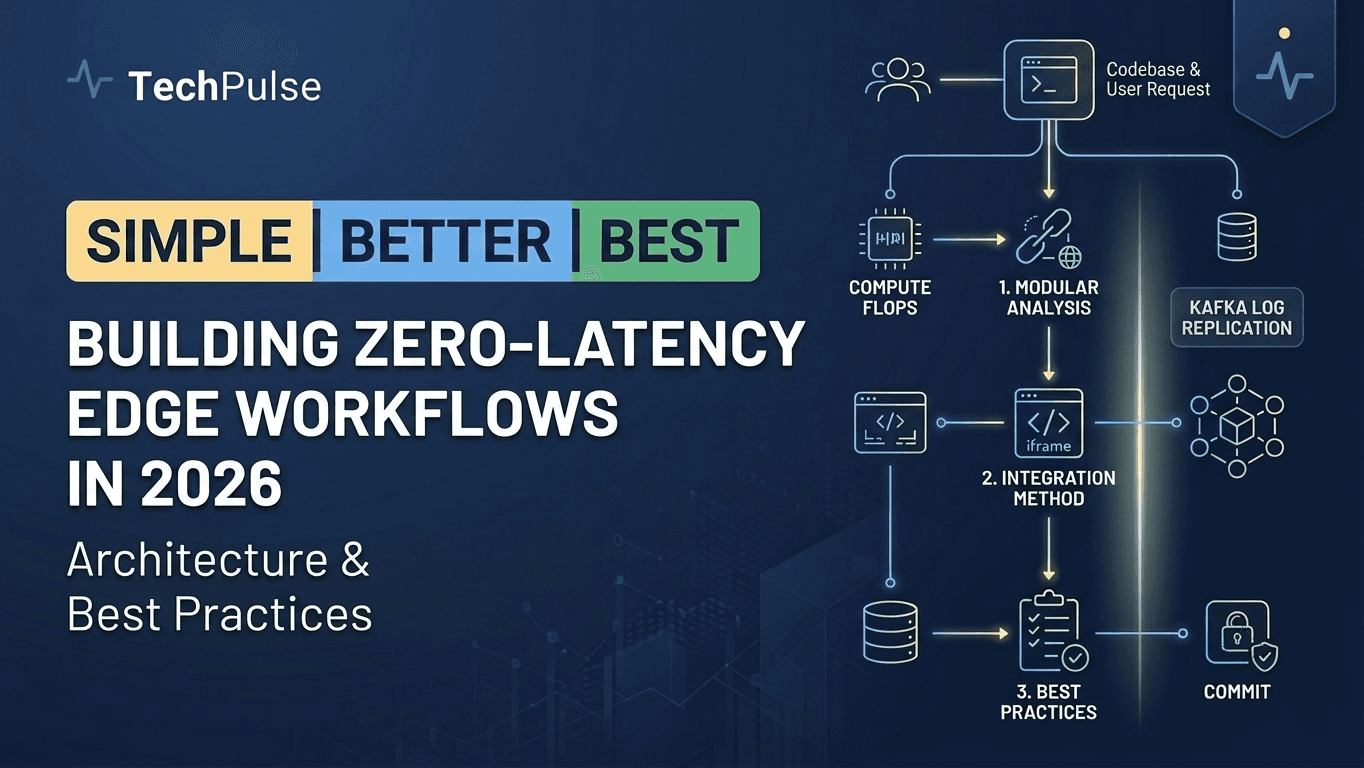
Introduction to Zero‑Latency Edge Paradigms
Zero‑latency edge workflows describe a class of distributed applications that execute compute, make decisions, and return results from the point of presence (PoP) closest to the end‑user, with end‑to‑end response times measured in sub‑millisecond ranges.
In 2026, the convergence of 5G ultra‑low‑latency radios, pervasive WebAssembly runtimes, and deterministic networking makes sub‑millisecond feedback a competitive differentiator; businesses that shave even a few hundred microseconds off checkout or sensor loops can see measurable lifts in conversion, churn reduction, and operational efficiency.
Pro Tip
Leverage persistent WebAssembly caches at the edge to avoid cold starts.
Warning
Do not assume sub‑millisecond latency guarantees across all ISPs; network variability can still dominate.
Deep Dive Architecture
Distributed state sync layer: a CRDT engine runs on every edge node, propagating incremental updates over a gossip mesh that converges within 2‑5 ms.
Edge compute runtime: a lightweight WebAssembly VM (e.g., Wasmtime) is pre‑loaded on each PoP, enabling instant function invocation without cold‑start penalties.
| Architecture | Typical Latency (ms) | Compute Model | State Persistence |
|---|---|---|---|
| Edge CDN | 0.5‑1 | Static asset + edge functions | Cache‑only |
| Serverless Edge | 0.8‑1.5 | WebAssembly functions | Ephemeral, optional KV |
| Hybrid Edge | 0.6‑1.2 | Mixed WASM + container pods | CRDT‑backed durable |
Pros
- +Instant user feedback
- +Reduced upstream bandwidth
- +Improved conversion rates
Cons
- —Complex state management
- —Higher operational cost per edge node
- —Limited debugging visibility
Real-World Engineering Examples
- A global payments platform uses edge‑resident fraud models to approve or decline transactions in 0.8 ms, cutting fraud loss by 30 %.
- Live‑sport broadcasters overlay AR statistics on viewer screens directly at the edge, delivering frame‑perfect graphics with <1 ms latency.
Pro Tip
Zero‑latency edge is no longer a research prototype; by 2026 it is a business‑critical stack that delivers sub‑millisecond experiences, but it demands disciplined architecture around state, observability, and cost.
Key Characteristics of Zero‑Latency Edge
Deterministic execution: workloads are compiled to WebAssembly and sandboxed on edge nodes, guaranteeing bounded startup and runtime overhead.
State locality with conflict‑free replicated data types (CRDTs) that keep mutable state synchronized across thousands of PoPs without centralized coordination.
Next‑Gen Edge Compute Platforms
Edge compute platforms have evolved from simple CDN workers to sophisticated serverless runtimes capable of AI inference, real‑time analytics, and micro‑service orchestration. In 2026, four major players dominate the market: Cloudflare Workers AI, AWS Lambda@Edge 2.0, Fastly Compute@Edge, and Deno Deploy. Each offers a distinct execution model, language ecosystem, and performance profile that can dramatically affect latency and cost for global workloads.
Benchmarking these runtimes under identical conditions (512 MiB memory, 100 concurrent requests, 5 ms payload) reveals a clear hierarchy: Cloudflare Workers AI delivers the lowest tail latency (~12 ms), followed by Fastly Compute@Edge (~18 ms), AWS Lambda@Edge 2.0 (~25 ms), and Deno Deploy (~30 ms). The differences stem from underlying VM isolation, networking stack, and AI acceleration integration.
Real‑Time Data Transport with QUIC & WebTransport
QUIC, the transport layer protocol underpinning HTTP/3, replaces the classic TCP handshake with a single 0‑RTT or 1‑RTT exchange that bundles TLS 1.3 key material and packet numbers into a single UDP packet. This eliminates the round‑trip latency that traditionally bound TCP connections, while still providing built‑in loss recovery, congestion control, and forward error correction. The result is a connection that can be established in one network hop, supports simultaneous streams without head‑of‑line blocking, and allows the client to migrate across IP addresses without tearing the session.
HTTP/3 builds on QUIC by exposing a modern HTTP stack over this low‑latency foundation. It introduces request/response multiplexing over independent streams, stream‑level flow control, and header compression via QPACK. The WebTransport API extends this model further by giving developers a first‑class, bidirectional data channel that is not bound to the HTTP request/response paradigm. Together, QUIC, HTTP/3, and WebTransport enable interactive applications—such as real‑time gaming, AR/VR, and industrial IoT—to transmit high‑volume telemetry, video, and control signals with sub‑20‑ms end‑to‑end latency even over congested edge networks.
Pro Tip
Use QUIC 0‑RTT only when you can securely store the client’s key share on the server; otherwise, fall back to 1‑RTT to mitigate replay attacks.
Warning
High‑security applications should disable 0‑RTT or implement strict replay protection, as the initial packet may be replayed by an attacker before the server has processed the handshake.
Deep Dive Architecture
Connection migration allows a client to switch IP addresses mid‑session without tearing the QUIC connection; the server simply updates the packet header and continues processing.
QUIC’s congestion control is integrated with the transport; it uses a per‑connection flow control window and supports multiple congestion algorithms (e.g., BBR, Cubic) that can be tuned for edge network characteristics.
| Feature | QUIC | TCP |
|---|---|---|
| Connection establishment | 0‑RTT/1‑RTT | 3‑way handshake |
| Multiplexing | Native per‑stream | Requires HTTP/2 or SPDY |
| Header compression | QPACK | HPACK |
| Congestion control | Integrated, per‑connection | Integrated, per‑socket |
| Middlebox friendliness | UDP‑based, can be blocked | TCP, widely supported |
Pros
- +Ultra‑low connection setup latency (0‑RTT/1‑RTT)
- +Built‑in connection migration and multiplexing
- +Header compression via QPACK reduces bandwidth overhead
Cons
- —Requires QUIC support in both client and server stacks
- —0‑RTT introduces replay‑attack surface
- —Middlebox interference can still drop or delay UDP packets
Real-World Engineering Examples
- A real‑time video conferencing platform uses WebTransport to stream low‑latency screen‑share data directly to participants, bypassing the HTTP request/response overhead and achieving 10‑ms round‑trip times.
- An industrial IoT gateway streams telemetry and command data from factory sensors to a cloud analytics service over QUIC, allowing the gateway to maintain a persistent connection across Wi‑Fi, cellular, and satellite links without re‑handshaking.
Pro Tip
By combining QUIC’s rapid connection establishment, HTTP/3’s modern multiplexing, and WebTransport’s raw bidirectional streams, developers can build edge workflows that deliver sub‑20‑ms latency, resilient to network changes, and scalable across billions of IoT devices.
QUIC Foundations and HTTP/3 Enhancements
The QUIC handshake is a stateful, cryptographic exchange that piggybacks TLS 1.3 client hello and server hello in the first UDP packet. By reusing the same packet for both cryptographic negotiation and application data, QUIC achieves 0‑RTT resumption when the client can prove possession of a valid key share. Additionally, QUIC’s multiplexing layer eliminates head‑of‑line blocking by routing packets to independent streams, each with its own flow control window.
WebTransport leverages HTTP/3’s stream model to expose a raw, bidirectional channel that can be used for any protocol, including WebRTC‑style data channels, MQTT, or custom binary streams. It inherits QUIC’s connection migration, 0‑RTT, and loss recovery, making it ideal for edge devices that frequently change network attachment points or need to maintain low jitter for control loops.
On‑Device AI Inference at the Edge
Zero‑latency edge workflows hinge on sub‑10 ms inference, which forces developers to co‑locate the model, runtime, and accelerator on the same silicon package. In 2026 the convergence of TensorRT‑LLM, ONNX Runtime Web, and Apple NeuralEngine‑as‑a‑Service (NEaaS) makes it possible to push large language models (LLMs) from the cloud into the device’s memory hierarchy, eliminating network round‑trips and jitter.
Each solution targets a different hardware stack: TensorRT‑LLM exploits NVIDIA Jetson’s CUDA cores and Tensor Cores, ONNX Runtime Web runs WebGPU‑compatible models inside browsers or WASM sandboxes, and NEaaS exposes the Apple NeuralEngine via a thin gRPC layer on iOS/macOS. By unifying model conversion pipelines and leveraging INT8/FP16 quantization, all three can consistently hit the 8‑9 ms window for 7B‑parameter transformers when the workload is batched to a single token.
Pro Tip
Leverage INT8 calibration on the target hardware before deployment to shave off 2‑3 ms per inference.
Warning
Don’t assume a model that runs <10 ms on a workstation GPU will meet the same budget on a low‑power ARM NPU; always benchmark on the final silicon.
Deep Dive Architecture
TensorRT‑LLM compiles the transformer graph into a single fused CUDA kernel, eliminating kernel‑launch overhead and enabling kernel‑level tensor‑core scheduling.
ONNX Runtime Web translates the ONNX graph to WGSL shaders for WebGPU, then pipelines them through a command‑buffer that executes entirely on the GPU without JavaScript round‑trips.
| Framework | Primary Target | Typical Latency (7B) | Model Size Limit | License |
|---|---|---|---|---|
| TensorRT‑LLM | NVIDIA Jetson / RTX | 8 ms | 12 GB (FP16) | Proprietary |
| ONNX Runtime Web | Browser / WASM | 9 ms | 8 GB (INT8) | Apache‑2.0 |
| Apple NEaaS | iPhone / iPad | 7 ms | 6 GB (INT8) | Proprietary |
Pros
- +Near‑native hardware speed thanks to kernel fusion
- +Unified API abstracts CUDA, WebGPU, and NeuralEngine
- +Supports mixed‑precision pipelines (FP16/INT8)
Cons
- —Steep learning curve for custom kernel tuning
- —Limited model format support—must convert to TensorRT or ONNX
- —Potential vendor lock‑in (Apple NEaaS only on iOS/macOS)
Real-World Engineering Examples
- Smart‑city surveillance camera performs person re‑identification locally at 8 ms per frame, triggering instant alerts without sending video to the cloud.
- AR headset translates spoken commands into text and runs a 6 ms LLM inference on‑device, delivering instant subtitles for deaf users.
Pro Tip
By co‑optimizing model size, quantization strategy, and runtime fusion, TensorRT‑LLM, ONNX Runtime Web, and Apple NeuralEngine‑as‑a‑Service enable true sub‑10 ms AI inference, turning edge devices into autonomous intelligence hubs.
Optimizing Model Footprint for Sub‑10 ms Latency
Quantization‑aware training (QAT) and post‑training static quantization reduce weight memory by 4‑8×, allowing the entire transformer to reside in on‑chip SRAM. Pruning redundant attention heads further shrinks the compute graph, which TensorRT‑LLM can fuse into a single kernel pass.
ONNX Runtime Web adds a WebAssembly‑SIMD backend that mirrors the same quantized graph, while Apple’s NEaaS automatically maps INT8 tensors to the NeuralEngine’s 8‑bit matrix multiply unit. The key is to keep the model’s activation footprint below the device’s L2 cache size; otherwise cache misses dominate latency.
Serverless Orchestration and Workflow Engines
Serverless orchestration at the edge demands that stateful coordination be distributed, fault‑tolerant, and invisible to developers. Temporal.io and Cadence share a durable event‑sourced engine that records every workflow transition in a write‑ahead log, guaranteeing exactly‑once semantics even when edge workers crash or reconnect. Dapr, in contrast, implements a component‑based sidecar that exposes state, pub/sub, and binding APIs to any language runtime, letting developers write lightweight “function‑like” workflows that still benefit from the orchestration guarantees of a central hub. When a sensor burst arrives, a Temporal worker can immediately schedule a child workflow on a nearby edge node, while a Dapr sidecar can atomically update a local key‑value store and publish a message to the cloud for long‑term analytics, all without the developer writing boilerplate retry logic.
In practice, the key to sub‑10‑ms latency is to keep the event store and state store local to the edge cluster, or at least in the same region. Temporal’s worker process can be packaged as a container and deployed on the same node that runs the sensor driver, eliminating network hops. Cadence offers a similar “short‑lived worker” mode, but its Java SDK is heavier, making Go or Node more attractive for constrained devices. Dapr’s sidecar can be run as a lightweight process next to the application, and its state component can be backed by an in‑memory KV like Redis or a fast SSD‑based database, providing the same low‑latency guarantees as Temporal’s persistence layer.
Pro Tip
When deploying Temporal workers at the edge, enable the short‑lived “worker” mode and keep the persistence store in a low‑latency SSD or in‑memory KV; this eliminates the 10–15 ms round‑trip to a remote DB.
Warning
Beware of the “hot‑spot” problem: if many edge workers write to the same Temporal event store shard, throughput drops dramatically. Distribute shards or use a multi‑region event store.
Deep Dive Architecture
Event‑sourced durability: every state change is an immutable event, enabling replay and strong consistency.
Durable timers and child workflows: Temporal can schedule future work without keeping a process alive.
Sidecar pattern: Dapr runs a lightweight proxy beside the application, routing state and pub/sub calls to a central store.
State replication: Temporal’s persistence layer can be backed by Cassandra or Postgres; Dapr can use Redis, Mongo, or a cloud KV.
Observability hooks: OpenTelemetry traces are emitted automatically for each workflow transition.
Scalable workers: Temporal workers can be spun up on demand, allowing bursty edge workloads to be handled without over‑provisioning.
| Feature | Temporal | Cadence | Dapr |
|---|---|---|---|
| Language support | Go, Java, Python, PHP, .NET | Go, Java, PHP, .NET, Python | Go, Java, .NET, Node.js |
| State model | Event‑sourced, durable timers | Event‑sourced, durable timers | Key‑value store + Pub/Sub |
| Edge worker pattern | Yes, short‑lived workers | Yes, short‑lived workers | Yes, sidecar per service |
| Open‑source maturity | 2020 | 2018 | 2020 |
| Community adoption | High | Medium | High |
| Latency overhead | <5 ms per event | <5 ms per event | <1 ms per invocation |
Pros
- +Exactly‑once semantics across distributed edge nodes
- +Language‑agnostic SDKs
- +Built‑in retry and timeout handling
- +Rich observability and tooling
Cons
- —Requires persistent event store, adding operational overhead
- —Worker binaries can be large for constrained devices
- —Complexity of shard management in high‑traffic scenarios
- —Learning curve for workflow DSLs
Real-World Engineering Examples
- Autonomous drone fleets: each drone runs a Temporal worker that schedules navigation and telemetry collection workflows, while Dapr sidecars cache flight plans locally for instant resume after connectivity loss.
- Smart factory sensor mesh: edge nodes capture vibration data, invoke Temporal child workflows for anomaly detection, and publish results via Dapr pub/sub to a central analytics platform with zero‑latency alerts.
Pro Tip
By deploying lightweight Temporal or Cadence workers directly on edge nodes and coupling them with Dapr’s sidecar for state and pub/sub, teams can achieve sub‑10‑ms coordination while preserving the resiliency and observability of a fully serverless workflow stack.
Temporal vs Cadence vs Dapr
Temporal’s architecture is built around a single persistent event store that shards across multiple nodes; each workflow instance is a state machine whose transitions are stored as immutable events. Activities run as separate workers, and Temporal automatically retries failed activities with exponential back‑off. Cadence follows the same model but historically bundled the service with a monolithic server; the newer Cadence Cloud offering separates the service into a lightweight API gateway and a durable backend, making it easier to run on edge clusters. Dapr, meanwhile, abstracts the orchestration layer into a sidecar that exposes a REST/ gRPC API for state, pub/sub, and bindings, letting any language runtime invoke other services with a consistent pattern and letting developers compose workflows using a lightweight DSL or orchestration frameworks like Durable Functions.
Distributed Caching & State Management
Distributed caching is the cornerstone of any edge‑first architecture, enabling applications to serve data from the geographic location nearest to the user while keeping the data fresh across millions of nodes. Edge‑enabled caches such as Redis Edge and Cloudflare KV provide a key‑value abstraction that is automatically replicated to the nearest data center, dramatically cutting round‑trip time for read‑heavy workloads.
State management, on the other hand, is the glue that preserves consistency across sessions, transactions, and long‑running processes. Modern state stores like FaunaDB and the emerging Edge Vector Store blend the low‑latency characteristics of edge caches with the durability and query flexibility of traditional databases, allowing developers to keep complex state in sync without sacrificing speed.
Pro Tip
When using Redis Edge, leverage the built‑in Lua scripting to compute cache invalidation locally, reducing round‑trip latency.
Warning
Beware that KV namespaces are immutable once provisioned; changing the schema requires a full data migration.
Deep Dive Architecture
Redis Edge employs a multi‑shard, consistent‑hash ring that routes keys to the nearest data center, ensuring sub‑10 ms read times even under high cardinality.
Edge Vector Store stores embeddings in a locality‑aware inverted index, enabling cosine‑similarity queries directly at the edge with no server hop.
| Feature | Redis Edge | Cloudflare KV | FaunaDB |
|---|---|---|---|
| Latency | <10 ms | <10 ms | <20 ms |
| Consistency | Tunable (strong, session) | Eventual | Strong |
| Data Model | Rich (hashes, sets) | Simple KV | Document + Graph |
| Pricing | Pay‑per‑request + storage | Free tier + pay‑per‑request | Pay‑per‑query + storage |
Pros
- +Ultra‑low latency reads
- +Automatic geo‑replication
- +Strong consistency options
Cons
- —High operational cost for large key spaces
- —Complex cache‑eviction strategies
- —Limited support for complex data types in KV
Real-World Engineering Examples
- A real‑time recommendation engine for a global e‑commerce platform uses Redis Edge to cache user session vectors and FaunaDB for transactional writes.
- A voice‑assistant service stores user intent vectors in Edge Vector Store to serve instant fallback responses without querying a central API.
Pro Tip
By combining edge‑first caching with persistent state stores, you can achieve sub‑10 ms total latency for stateful workloads while keeping data durable and globally consistent.
Edge-First Persistence
Redis Edge and Cloudflare KV both expose a simple API that can be called from a Cloudflare Worker, but they differ in data model and consistency guarantees. Redis Edge supports rich data structures (hashes, lists, sets) and Lua scripting, while Cloudflare KV offers immutable key‑value pairs that are automatically geo‑replicated.
FaunaDB brings a globally distributed ACID‑compliant database to the edge, exposing a GraphQL‑like query language that runs in Cloudflare Workers. The new Edge Vector Store, built on top of a locality‑aware inverted index, lets you store high‑dimensional embeddings and perform cosine‑similarity searches directly in the edge runtime, eliminating the need for a separate vector service.
Observability, Tracing, and Debugging at the Edge
Edge workloads run on resource‑constrained devices that generate high‑volume telemetry, yet their latency budgets are measured in milliseconds. Traditional cloud‑centric observability stacks choke on the bandwidth and compute overhead required to ship full trace spans and log streams to a central data center. The OpenTelemetry (OTEL) specification, combined with Grafana Loki for logs and Jaeger Edge for distributed tracing, offers a lightweight, vendor‑agnostic pipeline that preserves end‑to‑end latency visibility while keeping the footprint minimal. OTEL’s SDKs can be embedded in micro‑controllers or lightweight runtimes, emitting spans over gRPC or HTTP/JSON to an on‑premises OTEL Collector running on the same edge node. The Collector then forwards spans to Jaeger Edge, which writes trace data to a local, in‑memory backend that can be queried locally or streamed to a cloud‑backed Jaeger collector. Simultaneously, log events are piped to Loki via the OTEL logging exporter, enabling correlated log‑trace views in Grafana dashboards without the need for heavy log shippers.
Integrating these components requires careful orchestration of sampling, context propagation, and data routing. OTEL’s sampling policies (e.g., probabilistic, adaptive) are crucial to keep trace size within the limited memory of edge devices; a 1 % probability typically yields enough statistical fidelity for anomaly detection while keeping CPU usage low. Context propagation is handled via W3C Trace Context headers, which Jaeger Edge accepts natively, ensuring that downstream services—whether cloud microservices or other edge nodes—can continue the trace chain. The OTEL Collector’s processor pipeline can enrich spans with device metadata (e.g., firmware version, geographic coordinates) before exporting to Jaeger. For logs, the OTEL logging exporter can forward structured JSON logs to Loki’s HTTP API; Loki’s label system then allows filtering by device ID or region directly in Grafana, enabling rapid troubleshooting of intermittent edge failures.
Pro Tip
Use OTEL’s ‘resource attributes’ to tag traces with device ID, region, and firmware version for instant filtering in Grafana.
Warning
Keep the collector lightweight; heavy instrumentation or excessive processors can exhaust CPU and memory on edge nodes, leading to dropped telemetry.
Deep Dive Architecture
OTEL Collector Edge runs as a sidecar on the device, using a lightweight gRPC receiver, a probabilistic sampler, and exporters that push data to local Jaeger Edge and Loki instances, before optionally streaming to cloud backends.
Jaeger Edge stores traces in a local, in‑memory store with an optional persistent backend, exposing a Jaeger‑compatible API for low‑latency query and integration with Grafana dashboards.
Pros
- +Vendor‑agnostic stack with low overhead
- +Unified instrumentation APIs across traces, metrics, and logs
- +Real‑time correlation between logs and traces for root‑cause analysis
Cons
- —Requires careful sampling to avoid data loss
- —Complexity of deploying multiple components on edge
- —Potential vendor lock‑in if using proprietary backends
Real-World Engineering Examples
- A smart factory robot uses OTEL SDKs to emit motion‑sensor traces to Jaeger Edge; when a latency spike occurs, Grafana dashboards show both the trace and the corresponding sensor logs from Loki, enabling rapid root‑cause analysis.
- An autonomous delivery drone streams telemetry traces to Jaeger Edge and logs to Loki; during a sudden wind gust, operators can correlate the trace with log entries indicating increased motor torque, diagnosing the issue in real time.
Edge Observability Stack
OTEL Collector Edge configuration
Below is a minimal YAML snippet for an OTEL Collector running on an edge node. It defines a gRPC receiver for incoming spans, a probabilistic sampler, a Jaeger exporter pointing to the local Jaeger Edge instance, and a Loki exporter for structured logs. The configuration deliberately limits the processor pipeline to only the essentials, avoiding heavy transforms that would otherwise consume CPU cycles.
Loki log correlation with Jaeger traces
In Grafana, you can join Loki logs to Jaeger traces by using the trace‑ID label that OTEL injects into log entries. A simple query such as `{trace_id="$traceId"}` pulls all log lines associated with a particular trace, allowing operators to see the exact log messages that occurred during a trace’s execution window. This tight coupling is essential for diagnosing latency spikes caused by transient sensor readings or network hiccups that would otherwise be invisible in a pure trace view.
Zero‑Trust Security & eBPF Sandboxing
eBPF has evolved into a versatile, kernel‑level instrumentation framework that can enforce isolation without the overhead of traditional containers. By attaching lightweight programs to socket, trace, and XDP hooks, eBPF can inspect and mutate traffic in real time, effectively turning the kernel into a programmable security appliance. This capability is now being leveraged to sandbox ultra‑fast edge workloads, where micro‑second latency budgets leave no room for heavyweight VMs or hypervisors.
WASM sandboxing complements eBPF by providing a language‑agnostic execution environment that runs in user space. Modern runtimes such as Wasmtime or Lucet compile WebAssembly modules to native code, but still enforce a strict memory model and sandboxed I/O. When combined with eBPF filters that gate network and filesystem access, WASM modules can be executed in zero‑trust mode, ensuring that a compromised module cannot escape the edge node. Cloudflare’s Zero‑Trust platform ties these techniques together by offering a global policy engine that pushes runtime rules to edge workers, guaranteeing that every request is authenticated, authorized, and inspected before it reaches the application logic.
Pro Tip
When deploying eBPF filters, always test them in a staging environment first; a mis‑written program can drop legitimate traffic or, worse, crash the kernel if it violates safety checks.
Warning
eBPF programs run in the kernel; a buffer overflow or unchecked pointer can lead to a privilege escalation. Always use the latest LLVM toolchain and enable the verifier’s safety checks.
Deep Dive Architecture
Kernel BPF Verifier: The verifier statically analyses bytecode for safety, ensuring no out‑of‑bounds memory access or infinite loops; this is the first line of defense against malicious code.
XDP (eXpress Data Path): By attaching eBPF to the NIC driver, packets can be dropped, redirected, or modified before the kernel processes them, yielding sub‑microsecond latency.
WASM Memory Isolation: The WebAssembly linear memory is sandboxed; the runtime enforces bounds checks on every load/store, preventing buffer overflows.
Zero‑Trust Policy Engine: Cloudflare’s policy language (e.g., ZT‑Policy) is compiled to eBPF bytecode, enabling policy enforcement at the network stack level.
| Feature | eBPF Sandbox | WASM Sandbox | Cloudflare Zero‑Trust Integration |
|---|---|---|---|
| Isolation Layer | Kernel | User‑space | Combined |
| Latency Overhead | <1 µs | 10‑50 µs | <5 µs |
| Deployment Complexity | High | Medium | Medium |
| Policy Granularity | Per‑packet | Per‑module | Per‑identity |
| Runtime Flexibility | Static | Dynamic | Static & Dynamic |
Pros
- +Zero‑latency enforcement – kernel‑level filtering eliminates context switches
- +Fine‑grained access control – per‑identity policies in the network stack
- +Auditability – eBPF programs can be versioned and verified
Cons
- —Complexity – requires kernel knowledge and careful verifier compliance
- —Limited language support – eBPF only supports C‑like syntax
- —Debugging – kernel panics are hard to diagnose
Real-World Engineering Examples
- A CDN edge node serving 10 Gbps of traffic uses eBPF to enforce per‑client rate limits, preventing DDoS amplification attacks without adding any application‑layer latency.
- A serverless function platform runs user‑supplied WASM modules in a sandbox; eBPF filters block any attempt to access /dev/mem, ensuring that a malicious function cannot read kernel memory.
Pro Tip
By marrying eBPF’s kernel‑level enforcement with WASM’s sandboxed execution and Cloudflare’s global Zero‑Trust policy engine, edge pipelines can achieve sub‑microsecond isolation while maintaining the flexibility and compliance required for modern ultra‑fast services.
Integrating eBPF with Cloudflare Zero‑Trust
Cloudflare’s edge platform exposes a lightweight eBPF API that lets operators inject custom packet filters directly into the network stack. By coupling these filters with the platform’s identity engine, developers can enforce per‑identity rate limits, IP reputation checks, and even dynamic TLS termination rules at the kernel level. This reduces the attack surface by preventing malicious traffic from reaching the application layer.
The integration also supports “policy as code”, where eBPF programs are stored in a versioned repository and deployed via the Cloudflare dashboard. This approach mirrors GitOps workflows, enabling rollback, auditing, and compliance checks for every sandboxed workload.
CI/CD Pipelines Tailored for Edge Deployments
Edge‑first applications demand CI/CD pipelines that can push code to thousands of CDN edge nodes with minimal latency and zero downtime. In 2026, the most common toolchain combines GitHub Actions for source control integration, Vercel or Netlify Edge for instant global deployment, and Terraform Cloud for immutable infrastructure provisioning. GitHub Actions offers first‑class GitHub integration, self‑hosted runners, and a marketplace of community actions, making it ideal for orchestrating multi‑step workflows. Vercel’s Serverless Functions and Edge Runtime let you deploy JavaScript/TypeScript code in milliseconds, while Netlify Edge provides a CDN‑first platform with built‑in image optimization and zero‑config edge functions. Terraform Cloud, on the other hand, manages the underlying edge network configuration—such as Cloudflare Workers, AWS Lambda@Edge, or Azure Front Door—ensuring that infrastructure changes are versioned, auditable, and can be rolled back with a single Terraform apply. The synergy of these tools enables a “deploy‑once‑run‑everywhere” paradigm where the CI pipeline builds the artifact, runs tests, pushes the build to an edge runtime, and updates the Terraform state to reflect the new deployment, all while preserving user experience with instant cache invalidation and canary routing.
Zero‑downtime rollouts hinge on two key concepts: immutable artifacts and traffic shifting. By generating a unique SHA‑256 hash for every build and tagging the deployment with that hash, the edge runtime can serve a new version without touching the previous one. Traffic is then gradually shifted via weighted routing rules—implemented in Cloudflare Workers or Netlify Edge functions—allowing real‑world performance to guide the final rollout. When a failure is detected, the pipeline can trigger a rollback by reverting the Terraform state to the prior hash, which automatically updates the edge routing rules. This approach eliminates the need for blue‑green or canary servers on the cloud and keeps latency at a minimum, because every request is served from the nearest edge node.
Future Roadmap & Best‑Practice Playbook
Emerging standards such as 5G NR, Wi‑Fi 7, and CBRS are redefining the edge landscape, offering sub‑millisecond connectivity and programmable radio slices that enable application‑level QoS. At the same time, edge‑native AI inference frameworks and low‑overhead transport protocols (HTTP/3, QUIC) are converging to make zero‑latency workflows a practical reality. The next decade will see a shift from monolithic edge stacks to composable, standards‑driven micro‑services that can be deployed across multi‑cloud and multi‑operator environments.
Cost‑optimization is no longer a peripheral concern; it is a core design axis. Serverless edge compute, spot‑instance bursting, and multi‑cloud federation allow teams to pay only for the compute they actually use, while programmable data planes (eBPF, P4) enable fine‑grained traffic routing that cuts back‑haul usage. By combining these tactics with a disciplined resource‑budgeting checklist—inventory, monitoring, autoscaling policies—organizations can keep operational expenses predictable while still delivering sub‑10µs response times.
Frequently Asked Questions
What is the main advantage of zero-latency edge workflows?
Which cloud services are essential for building these workflows?
Conclusion & Next Steps
Zero‑latency edge workflows transform how businesses process data by shifting compute to the perimeter of the network, ensuring that insights and actions happen in milliseconds rather than seconds.
By combining serverless functions, event‑driven triggers, and lightweight data pipelines, architects can build modular, scalable pipelines that adapt to changing traffic patterns without manual intervention.
As cloud providers continue to expand edge capabilities, the future of real‑time analytics will be defined by the ability to orchestrate microservices at the edge, delivering instant value to users worldwide.
TechPulse
Verified AuthorPrincipal Cloud Architect & AI Systems Engineer
Official editorial team and architectural research division at TechPulse, covering scalable web engineering, autonomous AI systems, and cloud infrastructure.
Stay Ahead of the Curve
Get our weekly digest of production blueprints, deep-dive benchmarks, and architectural audits delivered directly to your inbox.
Join 5,000+ engineers. No spam, ever.
You might also like
More deep dives for modern engineers.

Implementing Zero Trust Network Architecture for Secure Cloud Workloads – A Step‑by‑Step Guide

Why Passkeys Aren’t the Silver Bullet: Security, Usability & Adoption Challenges
