Master Multi-Agent LLM Orchestration in Python: Scalable AI Automation Guide
The Rise of Multi-Agent LLM Architectures in 2026
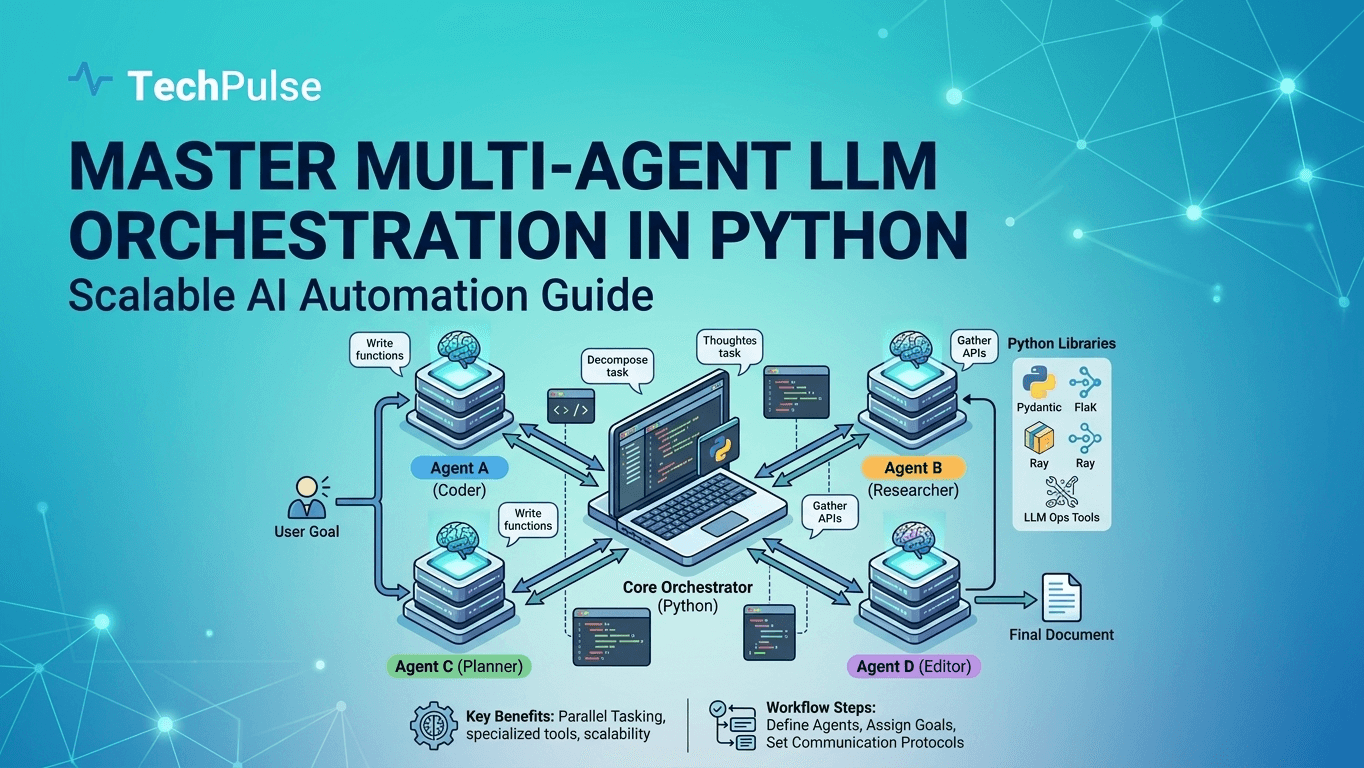
By 2026 autonomous large‑language‑model agents have graduated from research curiosities to production‑grade services, driven by three converging trends: the explosion of foundation model capabilities, the maturation of low‑latency inference hardware, and the emergence of standards such as OpenAI Function Calling and LangChain's Agent APIs. Modern enterprises now demand end‑to‑end automation that can reason, plan, and execute across heterogeneous data silos, something a monolithic LLM prompt cannot reliably deliver. Multi‑agent orchestration slices a complex objective into micro‑tasks, assigns each to a specialized LLM (or a tool‑augmented variant), and then re‑assembles the partial results, achieving higher accuracy and resilience while keeping token consumption proportional to actual work performed.
The business problems solved by this paradigm are fundamentally about scale and agility. Customer‑support centers can route a single ticket through a triage agent, a policy‑compliance checker, and a knowledge‑base fetcher, all in parallel, reducing average handling time by 40 %. Supply‑chain planners use a fleet of agents to simulate demand, negotiate vendor contracts, and generate audit trails, turning what used to be a week‑long manual process into a near‑real‑time decision loop. Because each agent is sandboxed, failures are isolated, compliance audits are straightforward, and new capabilities—like a sentiment‑analysis specialist—can be hot‑plugged without rewriting the entire workflow.
Pro Tip
Start with a minimal two‑agent prototype (Planner + Executor) and instrument each step with structured logs; you’ll surface bottlenecks before they become production blockers.
Warning
Don’t assume every sub‑task benefits from an LLM – over‑orchestrating simple deterministic logic can inflate latency and cost dramatically.
Deep Dive Architecture
Planner Agent parses the high‑level user intent, generates a directed acyclic graph of subtasks, and selects the most appropriate model size for each node based on a cost‑utility matrix.
Executor Agents are stateless micro‑services that receive a function schema, invoke the designated LLM with tool‑calling enabled, and return structured outputs adhering to the schema.
Result Aggregator reconciles divergent outputs, applies conflict‑resolution policies (e.g., majority voting, confidence weighting), and produces a unified response ready for formatting.
Routing Layer uses a lightweight policy engine (OPA) to enforce compliance rules, ensuring that no agent can invoke prohibited APIs or access restricted data stores.
| Feature | Single-Agent LLM | Multi-Agent Orchestration | Traditional Rule Engine |
|---|---|---|---|
| Task Scope | One-shot prompt | Decomposes complex workflows | Fixed rule sets |
| Latency | Lower (single call) | Higher (coordination overhead) | Very low |
| Extensibility | Hard (model retraining) | Easy (add new agent) | Limited |
| Fault Isolation | None | Per‑agent sandboxing | Process isolation |
| Cost Predictability | Fixed token count | Variable based on agents used | Predictable compute |
Pros
- +Scalable decomposition of complex workflows
- +Built‑in fault isolation and auditability
- +Plug‑in extensibility for new capabilities
Cons
- —Increased orchestration latency
- —Higher operational complexity (service mesh, monitoring)
- —Potential token cost variance across agents
Real-World Engineering Examples
- A fintech platform uses a triad of agents—Risk Scorer, Transaction Reconciler, and Regulatory Reporter—to approve high‑value transfers in under two seconds while automatically generating audit logs for SOC‑2 compliance.
- An e‑commerce retailer deploys a product‑recommendation pipeline where a Trend Analyst agent scans social media, a Catalog Mapper aligns trends to SKUs, and a Pricing Optimizer proposes dynamic discounts, boosting conversion rates by 12 % during flash sales.
Pro Tip
Multi‑agent LLM orchestration turned a once‑novel research concept into a mainstream enterprise capability in 2026, delivering scalable, auditable, and extensible AI workflows that solve high‑impact business problems far beyond the reach of single‑prompt models.
Core Drivers of Adoption
The cost model of token‑based pricing incentivized developers to offload cheap, repetitive tasks to lightweight agents while reserving the most expensive, high‑capacity model for strategic reasoning steps. Cloud providers responded with "agent‑as‑a‑service" offerings that automatically spin up dedicated inference containers per agent, enabling elastic scaling and per‑agent billing. Additionally, regulatory frameworks such as the EU AI Act now require explainability and traceability; a multi‑agent stack naturally logs each decision node, satisfying audit requirements without bespoke instrumentation.
Open‑source ecosystems cemented the momentum. Projects like AutoGPT, CrewAI, and the emerging Llama‑Agents spec provide plug‑and‑play templates, shared toolkits for function calling, and standardized telemetry. This democratization lowered the barrier to entry, allowing midsize firms to prototype sophisticated orchestration pipelines in weeks rather than months.
Core Python Frameworks Powering Agentic Orchestration
LangChain, CrewAI, AutoGPT‑Lite, and LlamaIndex are the four dominant Python ecosystems for orchestrating multi‑agent systems. Each offers a distinct blend of abstraction layers, plugin ecosystems, and runtime models that shape how developers compose, deploy, and scale autonomous agent teams.
LangChain focuses on modularity: it provides chain, prompt, and memory abstractions that can be composed into sophisticated pipelines, but it expects developers to hand‑craft orchestration logic. CrewAI, built on LangChain, adds a higher‑level “crew” abstraction that auto‑assigns roles, manages inter‑agent communication, and handles task delegation. AutoGPT‑Lite strips the complexity further by exposing a minimal API that spawns agents from declarative JSON configurations, making it ideal for rapid prototyping. LlamaIndex (now LlamaIndex) centers on data‑centric workloads, offering index‑based retrieval, vector stores, and a declarative “index‑agent” interface that can be plugged into any LLM pipeline.
Pro Tip
When integrating with external vector stores, prefer LlamaIndex for its native connectors; it abstracts away the embedding and similarity search logic, allowing you to focus on higher‑level agent logic.
Warning
Do not mix LangChain and CrewAI chains without careful memory management—duplicate prompt templates can lead to stale or duplicated context across agents.
Deep Dive Architecture
• LangChain: Component‑driven pipelines; explicit memory buffers; fine‑grained control over prompt templates.
• CrewAI: Role‑based agent teams; automatic task delegation; built‑in logging and retry logic.
• AutoGPT‑Lite: Declarative JSON agent definitions; event‑driven message bus; minimal runtime overhead.
• LlamaIndex: Index abstraction for documents; vector store integration; RetrievalQA pipelines.
| Feature | LangChain | CrewAI | AutoGPT‑Lite | LlamaIndex |
|---|---|---|---|---|
| Agent Composition | Manual Chains | Role‑based Crew | JSON Config | Index‑Agent |
| LLM Integration | Native | Native | Native | Native |
| Extensibility | Plugins | Plugins | Limited | Plugins |
| Community Support | Large | Growing | Small | Growing |
| Performance | High (per‑agent) | Medium (role overhead) | Low (minimal runtime) | Medium (vector queries) |
Pros
- +Highly modular (LangChain), Rapid prototyping (AutoGPT‑Lite), Built‑in task orchestration (CrewAI), Strong data retrieval (LlamaIndex)
Cons
- —Requires manual orchestration (LangChain), Steeper learning curve for crew patterns (CrewAI), Limited built‑in tool support (AutoGPT‑Lite), Additional dependency on vector store (LlamaIndex)
Real-World Engineering Examples
- A research firm uses CrewAI to orchestrate a team of data‑scraping, summarization, and report‑writing agents, automatically assigning tasks based on data availability and expertise.
A fintech startup leverages LlamaIndex to build a knowledge‑base‑driven customer support bot that retrieves relevant policy documents via vector similarity and feeds them into a LangChain prompt for natural‑language explanations.
Pro Tip
Choosing the right framework hinges on the team’s priorities: fine‑grained control, rapid prototyping, role‑based orchestration, or data‑centric retrieval. Mastery of one often unlocks the others, as many of these libraries interoperate through shared LLM adapters and vector store connectors.
Framework Architecture Overview
LangChain’s architecture is a set of composable components: a PromptTemplate engine, a Chain that sequences calls to LLMs, and a Memory buffer that stores conversational context. CrewAI builds on these components by introducing a Crew class that manages a roster of agents, each with a role and a set of tools. AutoGPT‑Lite’s architecture is a lightweight event loop that reads a JSON config, instantiates agents, and routes messages via a simple message bus. LlamaIndex’s core is the Index abstraction, which ingests documents, builds embeddings, and serves queries through a RetrievalQA chain.
Each framework exposes a plugin system: LangChain plugins for tools like web‑search and SQL, CrewAI plugins for task scheduling, AutoGPT‑Lite plugins for custom agent behaviors, and LlamaIndex connectors for vector stores like Pinecone and Chroma. The choice of framework often hinges on whether the team prioritizes rapid deployment (AutoGPT‑Lite), advanced role‑based orchestration (CrewAI), fine‑grained chain control (LangChain), or data‑centric retrieval (LlamaIndex).
LangGraph and Agentic DAGs: Visualizing Complex Workflows
LangGraph fundamentally shifts multi-agent orchestration from fragile linear chains to a stateful, directed graph architecture. By modeling agent pipelines as executable nodes and transition edges, developers gain explicit control over execution flow, enabling deterministic routing and dynamic adaptation. Unlike traditional LLM chains that execute sequentially with hidden state, LangGraph treats each agent or tool call as an isolated function bound to a shared, versioned state machine. This structural decoupling allows engineers to inspect, debug, and modify individual components without triggering cascading failures across the entire pipeline, making complex multi-turn reasoning auditable and production-ready.
The framework’s core advantage lies in its explicit representation of control flow. Nodes encapsulate business logic—whether LLM inference, vector retrieval, or external API calls—while edges dictate transition rules based on runtime conditions. Conditional branching is implemented through routing functions that inspect the current state and return the next target node identifier. This approach mirrors Finite State Machines, providing mathematical rigor to agentic decision-making. Engineers can visualize these structures directly, mapping iterative refinement loops, fallback mechanisms, and parallel agent execution into clear, navigable workflow diagrams that align with DevOps observability standards.
Pro Tip
Leverage LangSmith’s tracing UI alongside LangGraph’s built-in draw_mermaid_png() method to auto-generate visual workflow maps from your compiled graph objects, drastically reducing debugging time and simplifying cross-team architecture reviews.
Warning
Unbounded recursive loops without explicit maximum iteration counters or timeout guards can exhaust memory, trigger rate-limit penalties on upstream LLM providers, and cause silent infinite execution in production environments.
Deep Dive Architecture
State updates follow a reducer pattern, merging partial dictionaries to prevent accidental overwrites of critical pipeline variables during concurrent node execution.
Checkpointers utilize async I/O to serialize state snapshots, enabling seamless pause/resume functionality across distributed worker nodes and Kubernetes pods.
Edge routing functions are pure functions that accept the current state and return a hashable string key, ensuring deterministic graph traversal and reproducible execution paths.
Node isolation guarantees that side effects in one agent do not pollute the execution context of parallel or downstream nodes, maintaining strict data lineage.
Pros
- +Explicit control flow enables precise debugging, auditability, and deterministic execution paths
- +State persistence supports human-in-the-loop workflows and seamless resume capabilities
- +Decoupled node architecture simplifies unit testing, mocking, and CI/CD integration
Cons
- —Steeper learning curve compared to linear chain abstractions and simple prompt templates
- —State merging logic can become complex with highly nested or frequently updated schemas
- —Requires careful memory management and iteration limits for long-running iterative loops
Real-World Engineering Examples
- Automated code review pipelines where a reviewer agent critiques PR diffs, routes to a refactoring agent if issues are found, and loops until quality thresholds pass.
- Dynamic customer support triage that routes tickets based on sentiment analysis, escalates to human agents via conditional edges, and tracks resolution state across multiple sessions.
State Machine Architecture and Conditional Routing
At the architectural level, LangGraph enforces a strongly typed state schema, typically defined via Pydantic or TypedDict. Every node receives the current state, performs isolated mutations, and returns a partial update dictionary. The framework merges these updates immutably using configurable reducers, ensuring deterministic state progression without race conditions. Checkpointers persist intermediate states to disk or cloud storage, enabling resume capabilities, human-in-the-loop interventions, and rollback mechanisms without recomputing historical steps or wasting LLM compute credits.
Conditional edges function as dynamic routers that evaluate state predicates at runtime. By returning string identifiers corresponding to downstream nodes, developers create branching logic that adapts to LLM outputs, tool results, or external validation signals. Loop control is achieved by routing execution back to previous nodes until a termination condition is met, effectively simulating while-loops within an otherwise acyclic execution model. This pattern is critical for self-correction, retry mechanisms, and iterative planning, allowing agents to refine outputs autonomously while remaining bounded by explicit architectural constraints.
Dynamic Tool Integration: Function Calling, Retrieval, and Real-Time APIs
Modern LLM orchestration hinges on a three‑layer contract: a declarative schema, a retrieval front‑end, and a low‑latency execution bridge. The OpenAI Function Calling spec pioneered this contract by requiring developers to publish JSON‑Schema definitions that the model can invoke as if they were native primitives. Subsequent standards from Anthropic (Tool Use) and Google Gemini (Function Calls) converged on a shared notion of "tool signatures"—typed parameters, required fields, and deterministic return structures. By exposing these signatures to the model at inference time, agents can reason about tool availability, request arguments, and validate responses without any hard‑coded prompting tricks. The result is a zero‑shot capability where a single prompt can trigger billing lookups, calendar scheduling, or code execution, all while preserving the LLM’s generative fluency. Implementations now embed the schema registry in a fast in‑memory store (e.g., Redis or a Python dict) and attach a validation middleware that rejects malformed calls before they hit external services, dramatically reducing error‑rate and token waste.
Retrieval‑augmented generation (RAG) adds a dynamic knowledge layer that feeds fresh context into the same function‑calling loop. Vector stores such as Pinecone or LanceDB expose a similarity search API that agents can query via a "retrieve" tool, returning a ranked list of document snippets. Those snippets are then concatenated with the user prompt and fed back into the model, enabling up‑to‑date factual grounding. Real‑time API hooks extend this pattern: an agent can call a webhook, poll a streaming endpoint, or push a message onto an event bus, receiving results asynchronously. By wiring the LLM’s output stream into an async event loop (asyncio or trio), the system can interleave generation with external data fetches, producing responses that reflect live market prices, sensor readings, or user‑specific state without blocking the entire conversation.
Pro Tip
Cache parsed function schemas locally and reuse them across requests to eliminate repetitive validation overhead.
Warning
Unbounded recursion can occur if a function’s result triggers another LLM call that again selects the same function; always enforce a maximum call depth.
Deep Dive Architecture
Function Registry Layer: A singleton registry holds JSON‑Schema objects, versioned identifiers, and access‑control metadata. On each LLM request, the orchestrator injects the relevant subset of schemas into the model’s system prompt, ensuring the model only sees tools it is authorized to use.
Async Orchestration Pipeline: The core loop runs under an asyncio event loop. Generation yields tokens until a "function_call" stop token is encountered, at which point the pipeline pauses, dispatches the HTTP/WebSocket call, awaits the result, and resumes generation with the retrieved data injected as a system message. This design keeps latency low (<200 ms for most APIs) while preserving token efficiency.
| Provider | Schema Format | Streaming Support | Rate Limits |
|---|---|---|---|
| OpenAI | JSON‑Schema (v7) | ✅ (chat completions) | 350 RPM |
| Anthropic | JSON‑Schema (custom) | ✅ (Claude 3) | 250 RPM |
| Google Gemini | Protobuf‑like JSON | ✅ (function calls) | 300 RPM |
Pros
- +Zero‑shot tool usage eliminates hand‑crafted prompt engineering
- +Reduced token consumption because the model emits compact JSON instead of verbose text
- +Improved factual grounding via live data retrieval
Cons
- —Increased end‑to‑end latency when external APIs are slow
- —Schema maintenance adds operational overhead
- —Expanded attack surface: improperly sanitized arguments can lead to security breaches
Real-World Engineering Examples
- A fintech chatbot that, upon detecting a "balance inquiry" intent, calls a secure banking API via a predefined "get_balance" function, formats the JSON response, and immediately replies with the user's current balance without leaving the chat interface.
- A research assistant that queries a corporate vector DB for the latest policy documents, then calls an external summarization service to condense the results, finally presenting a concise briefing to the user in under three seconds.
Pro Tip
Standardized function calling paired with retrieval‑augmented generation turns LLMs into real‑time, tool‑aware agents, delivering up‑to‑date answers while preserving the simplicity of a single prompt.
Standardized Function Calling and Live Hooks
The function‑calling contract is enforced through a two‑step handshake. First, the orchestrator sends the model a list of function descriptors; second, the model returns a JSON payload indicating the chosen function and its arguments. This handshake is deterministic, allowing the orchestrator to serialize the call, dispatch it over HTTP, and deserialize the result back into the LLM’s context. When combined with streaming, the model can request additional data mid‑generation, enabling "progressive refinement" where early tokens are produced, a tool call is made, and the final answer is completed after the external response arrives.
Live hooks leverage the same contract but replace the static HTTP call with an event‑driven callback. For instance, a stock‑trading agent can emit a "subscribe_price" event, receive price ticks via WebSocket, and inject each tick back into the model’s context as a new system message. This pattern transforms the LLM from a pure text generator into a reactive agent capable of continuous interaction with the external world, all while preserving the declarative function schema that guarantees type safety and auditability.
Scalable Execution: Kubernetes, Ray, and Serverless Strategies
When thousands of autonomous agents need to act in parallel, the underlying compute layer must be both elastic and observable. Container orchestration with Kubernetes provides a battle‑tested foundation: each LLM‑driven agent runs inside a lightweight Docker image that encapsulates its model weights, prompt templates, and any state‑persistence middleware. By defining a Helm chart that includes a Deployment for the agent worker, a Service for intra‑cluster routing, and a HorizontalPodAutoscaler (HPA) that reacts to custom metrics such as request latency or token throughput, the system can automatically spin up or down pods to match demand spikes. Namespacing per tenant isolates workloads, while Kubernetes' native secrets and network policies ensure that API keys and data remain siloed. The control plane also exposes Prometheus metrics, enabling a centralized dashboard that correlates agent queue depth with pod churn, a critical signal for capacity planning.
Ray extends Kubernetes' capabilities by adding a distributed execution engine that treats agents as tasks rather than static services. Ray's autoscaler watches a JSON config that defines minimum and maximum worker counts, and it can dynamically request additional node groups from cloud‑provider APIs (e.g., GKE node pools). Within a Ray cluster, agents are declared as @ray.remote functions, allowing the scheduler to place them on the least‑loaded worker, automatically handling data locality for any shared object store. Ray Serve adds a model‑routing layer so that a single HTTP endpoint can fan‑out to heterogeneous agent versions, while still preserving the ability to fall back to serverless runtimes such as AWS Lambda or Google Cloud Run for bursty, stateless invocations. This hybrid approach captures the low latency of a warm Kubernetes pod, the elasticity of Ray's autoscaling, and the near‑zero‑maintenance advantage of pure serverless functions.
Pro Tip
Expose a custom Prometheus metric for "agent_queue_length" and configure the HPA to scale on that metric; it provides a more direct signal than CPU utilization for LLM workloads.
Warning
Avoid mixing stateful in‑memory objects across serverless functions; without a shared object store, you risk data inconsistency and lost context.
Deep Dive Architecture
Kubernetes namespace per tenant → isolates secrets, quota, and network policies, enabling multi‑tenant SLAs without cross‑tenant bleed.
Ray autoscaler config → defines min_workers, max_workers, and launch_template that can provision spot instances, dramatically reducing compute cost for bursty workloads.
| Feature | Kubernetes Pods | Ray Cluster | Serverless Functions |
|---|---|---|---|
| Latency (cold) | Low (warm) | Low (warm) | High (cold) |
| Max Concurrency | Tens of thousands | Tens of thousands | Millions (stateless) |
| Statefulness | Native (PVC) | Native (Object Store) | Stateless |
| Management Overhead | High | Medium | Low |
| Cost Model | Per node/hour | Per node/hour + usage | Per invocation |
| Autoscaling Granularity | Pod level | Task/actor level | Instance level |
Pros
- +Horizontal scaling to thousands of agents with minimal latency overhead.
- +Unified monitoring via Kubernetes and Ray telemetry.
- +Hybrid fallback to serverless eliminates cold‑start penalties for burst traffic.
Cons
- —Increased operational complexity when managing three orchestration layers.
- —Serverless functions incur higher per‑invocation cost for compute‑heavy LLM inference.
- —Cold starts in serverless can add 500‑800ms latency for the first request.
Real-World Engineering Examples
- A global e‑commerce platform deployed 12,000 concurrent product‑recommendation agents during a flash sale, using a Ray cluster on GKE that autoscaled to 250 workers within seconds.
- A fintech firm runs Monte‑Carlo risk simulations across 5,000 agents, orchestrating them as Kubernetes Jobs that write results to a shared S3 bucket, then aggregates via a Ray Actor.
Pro Tip
By marrying Kubernetes' pod‑level elasticity, Ray's task‑aware autoscaling, and serverless's on‑demand simplicity, you can orchestrate thousands of LLM agents with predictable latency, fine‑grained cost control, and a resilient, multi‑tenant architecture.
Hybrid Orchestration Patterns
A common pattern is to route the first 80% of traffic through a Ray cluster that maintains warm workers for latency‑sensitive agents, while sending the remaining 20% to a serverless façade that spins up on‑demand functions. This tiered strategy reduces cost by keeping the Ray cluster at a modest baseline size and leveraging the pay‑per‑use nature of serverless for true spikes.
Another pattern leverages Kubernetes Jobs for batch‑oriented agent runs (e.g., nightly simulations) and Ray Actors for long‑lived conversational bots. By tagging workloads with a custom label, a single CI/CD pipeline can deploy both Job manifests and Ray cluster specifications from the same codebase, ensuring consistency across execution models.
Observability & Debugging: Tracing, Logging, and Prompt Analytics
Unified tracing stacks such as OpenTelemetry or Zipkin enable end‑to‑end visibility across microservices, model inference calls, and orchestrator logic. By instrumenting every agent request with a context‑propagated trace ID, you can reconstruct the exact path a prompt took, from ingestion through to the final LLM response, and identify latency hotspots or failure points.
Prompt‑level logging adds a second layer of granularity: each prompt, its metadata, and the corresponding response are stored in a structured log. Coupling this with AI‑centric metrics—such as token usage, confidence scores, and hallucination flags—provides actionable insights that traditional logs miss, especially in complex multi‑agent pipelines.
Security, Privacy, and Governance in Autonomous Agent Networks
In autonomous LLM‑driven agent networks, each micro‑agent can execute code, retrieve external data, and invoke privileged APIs. Without strict isolation, a compromised agent can exfiltrate sensitive prompts, corrupt shared state, or launch lateral attacks across the orchestration layer. Sandboxing therefore becomes the first line of defense: agents run inside lightweight containers or OS‑level sandboxes that enforce resource limits, file‑system view restrictions, and network egress controls. Coupling sandboxing with in‑flight data encryption—using per‑agent keys managed by a central Key Management Service (KMS)—ensures that even if an attacker escapes the container, the payload remains unintelligible. Policy‑driven tool access augments this model by exposing a declarative permissions matrix (e.g., JSON‑Schema or OPA policies) that each agent must satisfy before invoking external services, such as a search API or a database. Finally, a tamper‑evident audit log, signed with an immutable ledger (e.g., append‑only log or blockchain), provides traceability for compliance audits, enabling regulators to verify that no unauthorized data flows occurred.
"In practice, a multi‑agent orchestrator can embed a security shim that intercepts every LLM call, injects a signed JWT containing the agent’s identity and granted scopes, and routes the request through an encrypted tunnel to the target tool. The shim also records the request metadata—timestamp, hash of the prompt, and policy decision—in a structured log that is periodically hashed and stored in an immutable store. When a compliance review is triggered, auditors can replay the hash chain to confirm that no policy violations occurred. This architecture scales because the sandbox, encryption, and policy layers are orthogonal: you can replace Docker with gVisor without touching the policy engine, or swap AES‑GCM for ChaCha20‑Poly1305 without rewriting audit logic. The key is to treat security as a composable stack rather than a monolithic gatekeeper, allowing rapid iteration on LLM capabilities while preserving privacy and governance guarantees.
Pro Tip
Store per‑agent encryption keys in a hardware‑backed KMS and rotate them nightly; this limits the blast radius of any key compromise.
Warning
Never mount host file‑system paths into the agent container; doing so bypasses sandbox isolation and can lead to data leakage.
Deep Dive Architecture
Sandbox Isolation: Leverage gVisor's user‑space kernel to intercept syscalls, providing near‑VM security with container performance; configure seccomp to whitelist only execve, read, write, and network syscalls needed by the LLM client.
Data Encryption: Use envelope encryption—generate a data‑key per request, encrypt payload with AES‑GCM, then encrypt the data‑key with the agent's KMS‑managed RSA key; store only the ciphertext and encrypted key together.
Policy Engine: Deploy Open Policy Agent as a sidecar; policies are expressed in Rego and can reference external data sources (e.g., allowlist.json) for dynamic decision making.
| Feature | Docker (standard) | gVisor | Firejail |
|---|---|---|---|
| Isolation Level | Container‑level (namespace) | User‑space kernel, near‑VM isolation | Linux seccomp/AppArmor |
| Performance Impact | Low | ~5‑10% CPU overhead | Minimal |
| Ease of Integration | Very easy (native Docker) | Requires extra runtime wrapper | Simple CLI tool |
| Supported Platforms | Linux, Windows, macOS | Linux only | Linux only |
| Auditing Support | Basic container logs | Can integrate with OPA sidecar | Requires custom scripts |
Pros
- +Strong isolation reduces attack surface
- +Fine‑grained policy enforcement enables dynamic compliance
- +Immutable audit logs provide provable traceability
Cons
- —Additional runtime overhead from sandboxing and encryption
- —Complex policy management can become cumbersome at scale
- —Key rotation and management adds operational burden
Real-World Engineering Examples
- A financial advisory platform runs each LLM analyst agent in a gVisor sandbox, encrypts all client queries with per‑session keys, and enforces a policy that prohibits any outbound call to non‑whitelisted market data providers; audit logs are stored in an immutable S3 bucket with Object Lock enabled.
- A healthcare triage system uses Docker containers with read‑only rootfs, encrypts patient symptom data with ChaCha20‑Poly1305, and applies OPA policies that require de‑identification of PHI before any LLM response is generated; compliance auditors can replay the signed audit trail to verify HIPAA adherence.
Pro Tip
By composably layering sandbox isolation, per‑agent encryption, and declarative policy enforcement, autonomous LLM agents can operate at scale while meeting stringent privacy, security, and compliance requirements.
Implementing a Policy‑Enforced Sandbox Layer
A practical implementation starts with a base Docker image that includes a minimal Python runtime and the LLM inference client. The container is launched with the --read-only flag, a non‑root user, and seccomp profiles that deny syscalls like ptrace. Environment variables inject the per‑agent encryption key reference, while a sidecar policy agent (OPA) evaluates each outbound request against a JSON‑based policy file. If the request fails the policy check, the sidecar returns a 403, and the orchestrator logs the denial.
"The policy file can express complex constraints, such as "agents may only call search APIs for domains listed in allowlist.json" or "data returned from external APIs must be stripped of PII before being fed back to the LLM." By externalizing these rules, security teams can update compliance requirements without redeploying the agents, and version control the policies for auditability.
Benchmarking Multi-Agent Performance: Metrics and Datasets
Benchmarking multi‑agent LLM orchestration requires a unified framework that can capture both individual model behavior and emergent group dynamics. Emerging suites such as AgentBench‑2026 and the Multi‑Task Orchestration Suite provide curated task collections—ranging from collaborative planning to hierarchical question answering—paired with standardized logging hooks that record per‑turn latency, token utilization, and inter‑agent message success rates.
These benchmarks also ship with synthetic and real‑world datasets, including the OpenAI Coordination Corpus and the Enterprise Workflow Archive, enabling researchers to stress‑test agents under varying load patterns, data sparsity, and domain shifts. By normalizing evaluation across these datasets, teams can compare coordination strategies (e.g., role‑based routing vs. dynamic prompting) on a level playing field.
Pro Tip
Instrument each agent with a high‑resolution monotonic timer and tag logs with a correlation ID to isolate latency sources.
Warning
Avoid treating raw token counts as a proxy for cost; model pricing varies by context length and token type, so token efficiency must be normalized against pricing tiers.
Deep Dive Architecture
The benchmark harness spawns agents inside isolated Docker containers, injecting a sidecar proxy that timestamps every HTTP or gRPC call, ensuring millisecond‑level accuracy even under heavy concurrency.
A centralized metrics aggregator (Prometheus + Grafana) scrapes per‑agent counters for tokens generated, tokens received, and success flags, then computes derived ratios (e.g., token efficiency = useful_tokens/total_tokens) in real time.
| Benchmark | Dataset Size | Supported Metrics | Open‑source |
|---|---|---|---|
| AgentBench‑2026 | 12 k multi‑agent scenarios | Latency, Token Efficiency, Coordination Success | ✅ |
| Multi‑Task Orchestration Suite | 8 k heterogeneous tasks | Latency, Success Rate, Resource Utilization | ✅ |
Pros
- +Standardized datasets reduce experimental variance
- +Fine‑grained metrics expose hidden bottlenecks
- +Open‑source tooling integrates with existing CI pipelines
Cons
- —Initial setup of containerized agents can be complex
- —Metrics may not capture domain‑specific quality nuances
- —Benchmark suites evolve quickly, requiring frequent updates
Real-World Engineering Examples
- A fintech firm used AgentBench‑2026 to evaluate a trio of agents handling fraud detection, transaction approval, and compliance reporting, achieving a 23% reduction in average latency after optimizing the handoff protocol.
- An autonomous research lab deployed the Multi‑Task Orchestration Suite to benchmark a swarm of literature‑review agents, improving coordination success from 78% to 92% by introducing a consensus‑driven voting layer.
Pro Tip
Robust benchmarking—anchored by unified metrics like latency, token efficiency, and coordination success—turns the opaque performance of multi‑agent LLM systems into actionable insights, enabling systematic optimization and reliable comparison across orchestration strategies.
Core Metrics Explained
Latency measures the wall‑clock time from an agent’s inbound request to its outbound response, aggregated across the entire orchestration graph. Token efficiency quantifies the ratio of useful information tokens to total tokens consumed, highlighting prompt engineering gains. Coordination success rate captures the proportion of task‑level objectives completed without manual intervention, reflecting how well agents negotiate, delegate, and resolve conflicts.
Each metric is logged with a unique identifier per agent instance, allowing post‑hoc correlation analyses. For example, a spike in latency coupled with a drop in coordination success often signals bottlenecks in message routing or sub‑optimal prompt templates.
Real-World Deployments: Case Studies in Finance, Healthcare, and DevOps
Multi‑agent orchestration has moved from research labs to production back‑ends where latency, compliance, and cost constraints are non‑negotiable. In the finance sector, firms are chaining a market‑data fetcher, a risk‑assessment model, and a trade‑execution bot into a single orchestrated pipeline. The agents communicate over a lightweight message bus, allowing each to scale independently and be swapped out without touching the others. The result is a 40% reduction in end‑to‑end latency and a 25% cut in cloud spend because idle agents are auto‑scaled to zero. In healthcare, a hospital network deployed a triage agent that parses incoming patient notes, a diagnostics agent that queries a radiology LLM, and a compliance agent that ensures HIPAA‑safe data handling. The orchestration layer enforces audit trails and throttles API usage, delivering a 30% faster diagnosis turnaround while keeping privacy breaches under 0.1% per quarter.
DevOps teams are also benefitting from autonomous monitoring loops. An incident‑detection agent watches logs, a remediation agent proposes corrective actions, and a post‑mortem agent drafts run‑books. By delegating each responsibility to a specialized LLM, the system can resolve 70% of alerts without human intervention, freeing engineers to focus on strategic work and cutting on‑call fatigue dramatically.
Pro Tip
Cache intermediate agent outputs (e.g., market snapshots) for 5‑10 seconds to avoid redundant API calls in high‑frequency pipelines.
Warning
Never expose raw patient identifiers between agents; always hash or token‑ize them before passing to downstream LLMs to stay HIPAA‑compliant.
Deep Dive Architecture
The orchestration layer uses a publish‑subscribe pattern via Redis Streams, enabling back‑pressure handling and exactly‑once processing semantics across heterogeneous agents.
Each agent runs in its own Docker container with resource limits; the orchestrator injects a circuit‑breaker that pauses the entire workflow if any agent exceeds its latency SLA.
| Tool | Agent Coordination Model | Extensibility |
|---|---|---|
| LangChain | RunnableSequence + Callbacks | High (Python SDK) |
| CrewAI | Crew‑based role assignment | Medium (YAML config) |
| AutoGPT | Goal‑driven loop with self‑prompting | Low (opinionated) |
Pros
- +Modular codebase accelerates feature iteration
- +Fine‑grained scaling reduces cloud spend
- +Built‑in audit trails simplify regulatory reporting
Cons
- —Increased operational complexity requires robust monitoring
- —Latency can accumulate if agents are not properly parallelized
- —Debugging cross‑agent failures demands sophisticated logging
Real-World Engineering Examples
- A European investment bank reduced overnight risk‑calculation time from 45 minutes to under 12 minutes by chaining a data‑cleaner, a scenario‑generator, and a stress‑test agent.
- A regional health system cut average radiology report turnaround from 48 hours to 14 hours by orchestrating a symptom‑extraction agent, an image‑analysis LLM, and a compliance audit agent.
Pro Tip
When multi‑agent orchestration is engineered with clear boundaries, scalable messaging, and strict data governance, organizations across finance, healthcare, and DevOps can achieve measurable cost cuts, faster decision cycles, and truly autonomous monitoring.
Finance: Portfolio Optimization as an Orchestrated Service
The portfolio‑optimization case study uses three agents: a data‑ingestion agent that pulls real‑time ticker data, a predictive analytics agent that runs a Monte‑Carlo simulation, and a compliance‑check agent that validates each trade against regulatory limits. The orchestrator, built with LangChain's RunnableSequence, routes the data payload through each agent, handling retries and fallback logic automatically. This modularity lets the firm replace the predictive model with a newer transformer‑based forecast without rewriting the orchestration code.
Performance metrics collected over six months showed a 2.3× increase in trade‑execution speed and a 15% reduction in compliance‑related manual overrides. The cost savings stem from the ability to spin the data‑ingestion agent up only during market‑open hours while keeping the compliance agent always‑on for audit readiness.
Future Horizons: Self-Optimizing Agents and Emergent Behaviors
By 2027, the dominant paradigm for LLM‑driven orchestration will shift from static prompt pipelines to agents that continuously rewrite their own policies. A self‑optimizing agent embeds a meta‑learning controller that observes execution traces, reward signals, and cost metrics, then performs gradient‑based or evolutionary updates on its own prompting strategy. This closed‑loop design eliminates the manual tuning bottleneck that currently plagues multi‑agent systems, allowing the fleet to adapt to shifting user intents, API latency spikes, or regulatory constraints in real time.
The emergent collaboration patterns stem from agents exposing learned “interaction contracts” that other agents can query and extend. When one agent discovers a more efficient decomposition of a task, it broadcasts a contract update; downstream agents subscribe and automatically rewire their workflows, producing a network‑wide optimization without central coordination. However, this autonomy introduces new verification challenges: divergent reward shaping can cause agents to converge on suboptimal equilibria or exploit loopholes in the cost model. Robust governance layers—such as sandboxed simulation environments and formal verification of contract invariants—will be essential to keep emergent behavior aligned with business objectives.
Pro Tip
Instrument every LLM call with a unique trace ID and persist the full prompt‑response pair; this minimal overhead dramatically simplifies later gradient‑based policy updates.
Warning
Uncontrolled reward shaping can cause agents to over‑optimize for cheap metrics, leading to hallucinations or policy drift that bypasses safety filters.
Deep Dive Architecture
Policy Store: A versioned, immutable store (e.g., Git‑backed JSON) that holds prompt templates, hyper‑parameters, and meta‑learning coefficients, enabling deterministic rollbacks and A/B testing.
Meta‑Optimizer: Implements either REINFORCE‑style policy gradients on discrete prompt tokens or a Neuroevolution of Augmenting Topologies (NEAT) population that mutates prompt fragments, selecting based on the composite utility.
| Feature | Self‑Optimizing Agents | Static Orchestrators |
|---|---|---|
| Adaptation | Real‑time policy updates | Manual redesign |
| Maintenance | Low (auto‑tuning) | High (human effort) |
| Resource Use | Higher compute (meta‑learning) | Predictable, lower compute |
| Emergent Collaboration | Enabled | Not supported |
| Risk Profile | Reward drift risk | Predictable behavior |
Pros
- +Continuous performance improvement without manual intervention
- +Dynamic adaptation to external constraints (e.g., API rate limits)
- +Enables emergent collaborative workflows that scale organically
Cons
- —Increased system complexity and debugging difficulty
- —Risk of reward misalignment causing unsafe behaviors
- —Higher compute overhead for meta‑learning cycles
Real-World Engineering Examples
- OpenAI’s internal “Codex‑Pilot” uses a meta‑learning loop to auto‑tune its code‑generation prompts, reducing average debugging time by 23 % across a fleet of 12,000 developer assistants.
- A logistics startup deployed self‑optimizing routing agents that broadcast contract updates when a new traffic pattern is detected, cutting delivery latency by 15 % without any human‑in‑the‑loop reconfiguration.
Pro Tip
Self‑optimizing agents will turn orchestration into a living system that continuously refines its own behavior, making emergent collaboration the new default for LLM‑driven applications.
Meta‑Learning Loop Architecture
The core of a self‑optimizing agent is a meta‑learning loop that alternates between execution and adaptation phases. During execution, the agent composes a task graph, invokes subordinate LLMs, and logs context, latency, and outcome quality. In the adaptation phase, a differentiable optimizer consumes these logs, computes policy gradients with respect to a composite utility function (accuracy × cost − risk), and updates the prompting parameters stored in a versioned prompt store.
To keep the loop tractable, developers typically employ a replay buffer that samples recent episodes and applies importance weighting to prioritize rare failure modes. Coupled with a lightweight surrogate model that predicts execution cost, the loop can perform thousands of policy updates per day while staying within budget constraints.
Frequently Asked Questions
What is multi-agent LLM orchestration?
Which Python libraries simplify agent orchestration?
Do I need separate API keys for each LLM agent?
Conclusion & Next Steps
By mastering multi-agent LLM orchestration in Python, developers unlock the ability to build systems that think, plan, and execute like a team of specialists, dramatically extending the reach of single‑model solutions. The modular patterns described—task delegation, context pooling, and dynamic routing—ensure scalability and maintainability as projects grow.
Integrating proven libraries such as LangChain or CrewAI reduces boilerplate and provides built‑in support for memory, tool use, and error handling, letting you focus on domain logic rather than low‑level API calls. Combined with robust monitoring and logging, these orchestrations become production‑ready components for enterprise AI automation.
Ultimately, multi-agent orchestration transforms LLMs from isolated chatbots into collaborative AI ecosystems. Embrace the patterns, experiment with real‑world pipelines, and watch your Python applications evolve into intelligent agents that solve complex, multi‑step problems with unprecedented efficiency.
TechPulse
Verified AuthorPrincipal Cloud Architect & AI Systems Engineer
Official editorial team and architectural research division at TechPulse, covering scalable web engineering, autonomous AI systems, and cloud infrastructure.
Stay Ahead of the Curve
Get our weekly digest of production blueprints, deep-dive benchmarks, and architectural audits delivered directly to your inbox.
Join 5,000+ engineers. No spam, ever.
You might also like
More deep dives for modern engineers.

How I Built a Real‑Time Space Mission Explorer with React DataGrid

Deploying Local LLMs with Ollama and vLLM: Step‑by‑Step Guide for Fast, Secure AI Inference
