Mastering GitOps: Deploy Seamless Kubernetes Apps with ArgoCD Workflow
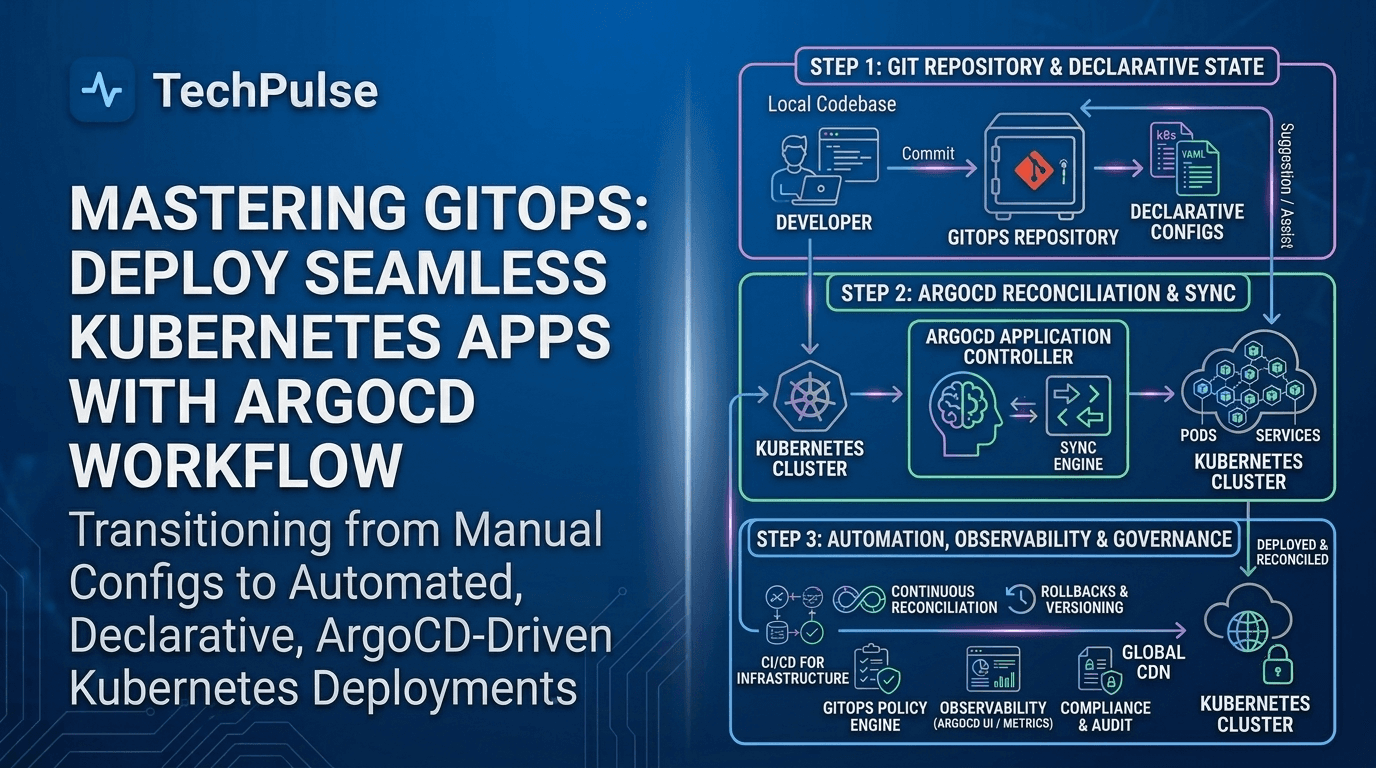
Introduction: Evolution of GitOps in 2026 and why ArgoCD dominates
By 2026, GitOps has transitioned from a niche methodology to a cornerstone of enterprise cloud strategy, with 85% of Fortune 500 companies reporting at least one production cluster governed by GitOps principles. The shift was driven by the need for observable, auditable change management at scale, and by the maturation of Kubernetes tooling that turned Git repositories into single source of truth.
ArgoCD has emerged as the dominant platform in this ecosystem, capturing roughly 48% of the GitOps market share according to the latest Cloud Native Computing Foundation (CNCF) survey. Its success is rooted in a robust feature set, a vibrant community, and tight integration with the broader Kubernetes ecosystem, making it the go‑to tool for modern DevOps teams.
Pro Tip
Leverage ArgoCD’s automated sync windows to align deployments with maintenance periods, reducing the risk of unplanned rollbacks during peak traffic.
Warning
Beware of stale manifests: ArgoCD will continuously reconcile, so any drift in cluster state can trigger unwanted rollbacks or re‑applications if the Git repo is not kept up‑to‑date.
Deep Dive Architecture
1. Git‑based declarative configuration with automatic diffing, rollback, and sync windows.
2. Built‑in policy engine and RBAC that integrates with OIDC, LDAP, and external policy servers.
| Tool | Market Share | Native Helm Support | GitHub Actions Integration |
|---|---|---|---|
| ArgoCD | 48% | Yes | Limited |
| FluxCD | 28% | Yes | Strong |
| GitHub Actions | 24% | No | Native |
Pros
- +Enterprise‑grade scalability and multi‑cluster support
- +Rich plugin ecosystem for observability and alerting
- +Native support for Helm, Kustomize, and plain manifests
Cons
- —Steep learning curve for complex sync strategies
- —Limited built‑in GitHub Actions integration
- —Requires separate ArgoCD instance per namespace cluster for strict isolation
Real-World Engineering Examples
- A global fintech bank uses ArgoCD to manage a fleet of 150 Kubernetes clusters across 12 regions, achieving 99.99% uptime and enabling instant rollback of a mis‑configured batch job that would otherwise have taken hours to correct.
- A media conglomerate deploys microservices via ArgoCD, leveraging its canary and blue‑green strategies to roll out new features with zero downtime and automated metrics‑based traffic shifting.
Pro Tip
ArgoCD’s mature ecosystem, declarative sync model, and tight Kubernetes integration make it the de facto choice for 2026 DevOps teams seeking reliable, scalable GitOps.
ArgoCD’s Core Strengths
ArgoCD’s declarative sync engine automatically reconciles cluster state with Git, providing instant diffs, visual rollbacks, and policy‑driven approvals that satisfy compliance teams. The platform also natively supports Helm, Kustomize, and plain Kubernetes manifests, giving teams flexibility without sacrificing consistency.
Security is baked in through fine‑grained RBAC, OIDC authentication, and a role‑based policy engine that can enforce branch protection, resource limits, and admission control. The extensible plugin architecture allows integration with Slack, PagerDuty, and custom webhook services, ensuring that ArgoCD fits into any existing alerting pipeline.
Core Architecture: ArgoCD, Kubernetes, and the modern GitOps stack
ArgoCD operates as a declarative Git‑driven continuous delivery controller that watches a Git repository for desired state definitions and continuously reconciles that state against a target Kubernetes cluster using the Kubernetes API. Its sync loop performs a diff between the live cluster and the Git manifest, then applies the necessary Kubernetes manifests (via kubectl or client libraries) to converge the cluster to the declared state, optionally pruning obsolete resources and executing pre‑sync hooks. This tight coupling to the Kubernetes API and the ability to run arbitrary sync hooks makes ArgoCD a versatile engine for managing multi‑cluster, multi‑environment workloads in a single, auditable source of truth.
The surrounding GitOps stack is comprised of a Git provider (GitHub, GitLab, Bitbucket, or self‑hosted Git), a source‑control‑based CI pipeline that builds container images and pushes them to a registry, Helm or Kustomize templates that package application manifests, and observability tooling such as Prometheus and Grafana for monitoring ArgoCD health and rollout metrics. Optional add‑ons like Argo Rollouts enable progressive delivery strategies (canary, blue/green), while secrets management solutions (SOPS, SealedSecrets, Vault) keep sensitive data out of plain‑text Git. Together, these components form a resilient, observable, and secure GitOps pipeline that can scale from single‑team prototypes to enterprise‑grade multi‑team deployments.
paragraphs
:
The Git provider serves as the authoritative source of truth; any change to an application manifest or Helm chart triggers a webhook that notifies ArgoCD to re‑evaluate the sync loop. CI pipelines can automatically tag images and commit the new image tags back to Git, ensuring that the Git history reflects every deployed version. Helm and Kustomize act as templating engines that generate the final Kubernetes manifests on the fly, allowing teams to maintain reusable, parameterized configurations. Observability tools ingest ArgoCD metrics and logs, providing real-time dashboards that expose sync status, rollout progress, and health checks, thereby closing the feedback loop that is central to GitOps.
ArgoCD’s integration with OIDC and RBAC ensures that only authorized users can trigger syncs or view application states, while the ApplicationSet controller can auto‑generate Application resources for a fleet of microservices, reducing manual overhead. The overall architecture is designed to be declarative, auditable, and self‑healing, making it ideal for continuous delivery at scale.
paragraphs
:
Declarative Pipelines: Integrating Tekton and GitHub Actions for CI in a GitOps flow
Combining GitHub Actions with Tekton pipelines lets teams keep the familiar GitHub workflow UI while moving the heavy lifting—building, testing, and packaging—into Kubernetes-native, declarative resources. The GitHub Actions step validates source code, runs quick linting, and then emits a webhook or directly invokes the Tekton CLI to create a PipelineRun, ensuring that every artifact is built inside the cluster and versioned in Git. This approach keeps the CI/CD chain fully declarative: the Git repo contains the Actions workflow, the Tekton pipeline spec, and the ArgoCD application manifest, so the entire pipeline lives in Git and can be diffed or rolled back.
When a push occurs, a GitHub Actions workflow can either trigger a Tekton Trigger webhook or run `tkn pipeline start` from a runner. The Tekton pipeline then pulls the source from the same commit, runs unit tests, builds a container image, and pushes it to a registry. Because the pipeline is defined in Kubernetes Custom Resources, it can be scheduled, retried, or scaled by the cluster itself, and the results are stored in Git as a PipelineRun CR, providing auditability and traceability.
Policy‑as‑Code & Security: OPA Gatekeeper, Kyverno, and automated compliance
Integrating policy-as-code into a GitOps pipeline transforms security from a manual gate into an automated, immutable enforcement layer. When ArgoCD reconciles application state, it submits manifests to the Kubernetes API server, triggering mutating and validating admission webhooks that route requests to policy engines like OPA Gatekeeper or Kyverno. This architecture ensures that every sync operation undergoes deterministic compliance evaluation before resource creation or modification. By embedding governance directly into the control plane, engineering teams eliminate configuration drift and prevent non-compliant workloads from ever reaching production clusters. The webhook architecture intercepts requests synchronously, guaranteeing that ArgoCD’s declarative state aligns with organizational security baselines without requiring external scanning tools.
The enforcement mechanism operates during the admission phase, returning structured rejection payloads that cause ArgoCD to mark resources as out-of-sync or failed upon violation. This feedback loop enables continuous compliance auditing while maintaining Git as the single source of truth. Teams can leverage curated policy libraries to standardize container runtime settings, network isolation, and RBAC constraints across multi-tenant environments. By coupling policy evaluation with ArgoCD’s sync wave orchestration, platform engineers can sequence governance resources before workloads, preventing transient admission failures that halt deployment pipelines. This shift-left approach ensures security decisions are version-controlled, peer-reviewed, and automatically applied across all cluster environments.
Pro Tip
Use conftest or kyverno apply in your CI pipeline to validate manifests against policy libraries before pushing to the Git repository, catching violations before they reach the cluster.
Warning
Running policy engines in enforce mode with overly restrictive rules can cause ArgoCD to report perpetual out-of-sync states if not properly aligned with your Git source of truth.
Deep Dive Architecture
Admission webhooks intercept API server requests, serializing them to JSON for policy evaluation before resource persistence.
OPA Gatekeeper utilizes Rego, a declarative query language, while Kyverno relies on native Kubernetes YAML, reducing the learning curve for platform engineers.
ArgoCD integrates with both engines via webhook timeouts and retry logic, ensuring policy evaluation failures do not cascade into sync loops.
Policy audit controllers continuously scan existing cluster state, reconciling drift by generating compliance reports or automatically patching resources.
Pros
- +Automated compliance enforcement at the admission layer
- +Native integration with Kubernetes API server
- +Declarative policy management versioned in Git
Cons
- —Steep learning curve for Rego-based policy authoring
- —Admission webhook latency can impact sync performance
- —Complex troubleshooting when policies conflict with Git state
Real-World Engineering Examples
- Enforcing image provenance by rejecting containers lacking SBOM attestations or unsigned registries during ArgoCD syncs.
- Mandating resource requests and limits across all workloads to prevent node starvation and ensure fair scheduling in shared Kubernetes environments.
Sync Wave Orchestration & Policy Evaluation
ArgoCD’s sync wave feature allows precise control over resource creation order, which is critical when policies depend on prerequisite configuration maps or service accounts. By delaying policy-sensitive workloads until foundational governance resources are applied, you prevent transient admission failures that halt entire application syncs. Additionally, policy engines can be configured in audit-only mode during initial rollout, allowing teams to validate compliance posture without disrupting active GitOps workflows before switching to enforce mode.
Multi‑Cluster & Edge Scaling: Managing thousands of clusters with ArgoCD Projects and ClusterSets
Scaling GitOps across heterogeneous environments demands a hub-and-spoke topology where a central ArgoCD instance orchestrates deployment pipelines while delegating execution to distributed Kubernetes clusters. ArgoCD Projects provide logical namespaces that enforce RBAC boundaries, source repositories, and destination constraints, preventing configuration sprawl. When paired with ClusterSets, operators can declaratively manage thousands of clusters by grouping them via labels or geographic regions, enabling batch synchronization without overwhelming the control plane.
Edge environments introduce unique latency and connectivity challenges. ArgoCD’s controller leverages efficient diffing algorithms and webhook-driven reconciliation to minimize API server load. By configuring resource health ignore rules and tuning self-heal intervals, teams reduce reconciliation storms during network partitions. RBAC policies must be strictly scoped to Project-level ServiceAccounts, ensuring that edge gateways only receive read-only access to manifests and write permissions to their designated namespaces.
Pro Tip
Cache manifest diffs locally on edge nodes using Redis to reduce ArgoCD controller CPU usage during high-frequency syncs and prevent API throttling.
Warning
Misconfigured RBAC bindings at the Project level can inadvertently grant cross-cluster write access, creating security drift in multi-tenant environments. Always audit destination constraints regularly.
Deep Dive Architecture
ArgoCD controllers utilize a watch-based reconciliation loop that compares live cluster state against Git manifests, triggering sync waves only on delta detection to conserve bandwidth.
ClusterSets leverage Kubernetes dynamic client capabilities to discover clusters via label selectors, automatically provisioning Application resources with correct server and namespace fields.
Project-scoped RBAC enforces least-privilege access by binding ServiceAccounts to specific Git paths and cluster destinations, preventing lateral movement across tenants.
Edge deployments benefit from offline sync capabilities when paired with ArgoCD’s import/export workflows and local registry mirrors for air-gapped nodes.
| Feature | ArgoCD | Flux | Custom Operator |
|---|---|---|---|
| Multi-Cluster Support | Native via ClusterSets | Limited, requires external tooling | Fully customizable |
| RBAC Granularity | Project-level scopes | ClusterRole bindings | Developer-defined |
| Edge Optimization | Webhook-driven sync, diff caching | Pull-based, high latency tolerance | Depends on implementation |
| Control Plane Scaling | Horizontal controller scaling | GitPolling intervals | Resource-intensive |
Pros
- +Declarative cluster lifecycle management via ClusterSets
- +Strict RBAC enforcement through Project boundaries
- +Reduced control plane load with targeted sync waves
Cons
- —Complex RBAC matrix requires rigorous audit trails
- —Edge network partitions can cause reconciliation backlogs
- —Large Application counts increase controller memory footprint
Real-World Engineering Examples
- Global telecom operators deploy 5G edge nodes across 5,000+ locations using ArgoCD Projects to isolate regional compliance policies while synchronizing core telecom workloads from a central Git repository.
- Financial institutions run hybrid cloud architectures where ArgoCD ClusterSets automatically provision regulated workloads to on-premises clusters while routing non-sensitive microservices to public cloud spokes.
Pro Tip
Mastering ArgoCD Projects and ClusterSets transforms multi-cluster GitOps from a manual overhead into a scalable, policy-driven operation, ensuring consistent delivery across cloud and edge boundaries.
Architectural Patterns for Distributed GitOps
Implementing a multi-cluster strategy requires separating Git repository structures into environment-scoped directories and leveraging ArgoCD’s application hierarchy. Hub clusters host the ArgoCD control plane, while spoke clusters run lightweight agents or rely on direct API communication. ClusterSets automate cluster registration by matching clusterName or region labels, dynamically generating Application resources that target the correct endpoints. This architecture eliminates manual cluster onboarding and ensures consistent policy enforcement across cloud and edge nodes.
AI‑Assisted Operations: Using LLM‑powered bots for drift detection and PR generation
Large Language Models (LLMs) can now be integrated directly into the ArgoCD event stream to perform real‑time drift analysis. When ArgoCD reports a configuration drift, the bot consumes the event payload, cross‑references the desired state manifests, and applies semantic similarity checks to determine if the drift is intentional or accidental. By leveraging embeddings of YAML structures, the bot can rank drift causes and surface actionable insights to operators via a chat interface or Slack message, effectively acting as a conversational Ops assistant.
Once a drift is confirmed as accidental, the LLM can auto‑generate a pull request that re‑establishes the desired state. It constructs a minimal set of patch files, drafts a descriptive commit message, and even includes unit‑test snippets for new resources. The bot then pushes the PR to the Git repository and triggers ArgoCD to reconcile, closing the loop with a single command—‘apply drift’—all without operator intervention. This end‑to‑end automation reduces mean time to resolution (MTTR) and eliminates human error in manual edits.
Observability & SLO Automation: Prometheus, Grafana, and automated remediation via ArgoCD notifications
In a GitOps pipeline, observability is the nervous system that detects drift, SLA violations, and performance regressions. By wiring Prometheus alert rules directly to ArgoCD notifications, you can turn a metric breach into a declarative sync operation that reconciles the live cluster back to the desired state stored in Git.
Grafana dashboards surface SLO burn‑rate and latency trends, while Prometheus records high‑resolution time‑series. When an alert fires, Alertmanager forwards a payload to the ArgoCD notification controller, which then triggers a sync, optionally with a custom parameter set that forces a rollout of a new canary or applies a pre‑approved remediation manifest.
Pro Tip
Leverage Prometheus recording rules to pre‑aggregate SLO metrics before alerting; this reduces alert noise and ensures consistent thresholds across environments.
Warning
Do not set the Prometheus evaluation interval equal to the ArgoCD sync interval; mismatched timing can cause flapping syncs and unnecessary pod restarts.
Deep Dive Architecture
Prometheus scrapes metrics from all services, stores them in a TSDB, and evaluates SLO recording rules that compute error‑budget consumption and burn‑rate.
Alertmanager routes SLO breach alerts to an ArgoCD notification receiver, which uses a templated payload to call the ArgoCD API, optionally passing a Helm values override for remediation.
| Feature | ArgoCD Notifications | Custom Webhook |
|---|---|---|
| Alert routing | Built‑in Alertmanager integration | Manual routing logic |
| Retry logic | Configurable exponential backoff | Must be implemented |
| Native RBAC | Leverages ArgoCD RBAC policies | Separate auth layer required |
| Observability | Emits Prometheus metrics for notification delivery | No out‑of‑the‑box metrics |
Pros
- +Zero‑touch remediation eliminates manual incident response latency
- +Unified metrics and deployment view simplifies SLO governance
- +Native RBAC integration ensures only authorized syncs are executed
Cons
- —Adds operational complexity to the GitOps stack
- —Potential race conditions if multiple alerts trigger concurrent syncs
- —Higher CPU and memory usage on the notification controller
Real-World Engineering Examples
- A fintech API team defines a 99.9% latency SLO. When the 5‑minute latency burn‑rate exceeds 2×, an alert triggers ArgoCD to roll back the last deployment, automatically restoring service performance.
- A SaaS provider monitors database connection errors. Upon crossing a 1% error‑budget threshold, ArgoCD syncs a ConfigMap that increases the replica count of the affected service, scaling out to absorb load.
Pro Tip
By coupling Prometheus‑driven alerts with ArgoCD notifications, you achieve self‑healing, SLO‑compliant deployments that react automatically to performance deviations, turning observability data into actionable GitOps actions.
Alert‑Driven Sync Loop
The loop starts with a recording rule that aggregates SLO error budgets over a 5‑minute window. If the burn‑rate exceeds a threshold, an alert is generated and routed to a dedicated receiver in Alertmanager.
ArgoCD notifications consume the alert, map it to an Application resource, and invoke a sync with the '--prune' flag. The sync can be gated by a health check that ensures the remediation does not violate other SLOs.
GitOps for Serverless & Service Mesh: Integrating Knative and Istio with ArgoCD
In a GitOps model, every change to a serverless workload or a service‑mesh policy is stored as code in a Git repository. ArgoCD continuously reconciles that desired state with the live Kubernetes cluster, ensuring that Knative services and Istio configuration are always in sync with version‑controlled manifests. This approach eliminates drift, provides auditable rollbacks, and lets developers treat infrastructure the same way they treat application code.
When a developer pushes a new Knative Service YAML or updates an Istio VirtualService, ArgoCD detects the commit, pulls the manifest, and applies it using the cluster’s API server. Because both Knative and Istio extend the Kubernetes API, ArgoCD can manage them without custom plugins, leveraging its native support for Kustomize, Helm, or plain manifests.
Pro Tip
Leverage ArgoCD’s resource hooks to run "kubectl wait --for=condition=Ready" on Knative Services, ensuring the rollout only proceeds after the serverless pod is fully initialized.
Warning
Do not store raw Docker images in the same repo; keep image references immutable (e.g., digest tags) to prevent accidental redeployments of untested binaries.
Deep Dive Architecture
ArgoCD watches a single Git branch per environment; each branch contains a Kustomize overlay that injects Istio sidecar annotations into Knative Service pods, enabling seamless mesh integration without manual edits.
Knative’s autoscaling (KPA/HPA) and Istio’s traffic management are reconciled independently; ArgoCD treats them as separate resources, so a failure in one does not block the other, but you can define dependency hooks if ordered rollout is required.
| Feature | Knative | Istio |
|---|---|---|
| Primary Goal | Serverless compute (scale‑to‑zero) | Service‑mesh traffic management |
| CRD Types | Service, Revision, Configuration | VirtualService, DestinationRule |
| Autoscaling | Built‑in KPA/HPA | Not built‑in, relies on sidecar |
| Traffic Splitting | Native (percentages per Revision) | Advanced (mirroring, fault injection) |
| Integration Point | Deploy via Deployment-like manifests | Inject sidecar via namespace annotation |
Pros
- +Unified declarative control for serverless and mesh resources
- +Automatic drift detection and rollback via Git history
- +Native Kubernetes API support eliminates need for custom operators
Cons
- —Increased manifest complexity when mixing Knative and Istio CRDs
- —ArgoCD UI can become noisy with high‑frequency Knative revisions
- —Requires careful version pinning of CRD schemas to avoid breaking changes
Real-World Engineering Examples
- A fintech platform uses ArgoCD to deploy a Knative Service that processes real‑time transactions; Istio VirtualService routes 10% of traffic to a new version for canary testing, all driven by a single Git commit.
- An e‑commerce site defines a Kustomize overlay that adds "istio-injection=enabled" to its namespace and a Knative Service manifest; ArgoCD automatically rolls out the changes across dev, staging, and prod clusters with zero downtime.
Pro Tip
By treating Knative and Istio resources as first‑class GitOps artifacts, ArgoCD provides a single source of truth for both serverless workloads and mesh policies, delivering rapid, auditable, and safe deployments across any Kubernetes environment.
Declarative Deployment Pipeline
A typical pipeline checks out the GitOps repo, runs a Kustomize build that overlays environment‑specific patches (e.g., different traffic splitting rules for canary releases), and commits the rendered output to a separate "rendered" directory that ArgoCD watches. This separation keeps raw source files clean while still providing a reproducible, immutable deployment artifact.
ArgoCD’s health checks are extended with custom Lua scripts to understand Knative’s "Ready" condition and Istio’s "Configured" status, allowing the UI to surface precise health metrics for serverless functions and mesh routing rules alike.
Disaster Recovery & GitOps Backups: Strategies with Velero, Stash, and Git snapshots
In a GitOps‑centric environment, disaster recovery (DR) is no longer a separate, manual process but an integral part of the continuous delivery pipeline. By treating the entire cluster state—persistent volumes, custom resources, and Helm releases—as versioned code, teams can automate failover, restore, and even cluster migration with a single git commit. Velero excels at capturing immutable snapshots of PersistentVolumeClaims (PVCs) and cluster‑wide resources, while Stash provides application‑aware backup policies that hook into sidecar containers for in‑pod data extraction. Complementing these tools, Git snapshots of Helm values, Kustomize overlays, and ArgoCD Application manifests act as a source‑of‑truth ledger that can be replayed on a fresh cluster in seconds. The synergy of block‑level backups and declarative Git state creates a two‑layer safety net: Velero/Stash guard against data loss, and Git guarantees that the desired configuration can be reconstituted without manual intervention.
When a catastrophic event occurs—whether a region‑wide outage, a rogue admin command, or a storage corruption—recovery proceeds in a deterministic sequence. First, the Git repository is cloned to a clean control plane, and ArgoCD is pointed at the repo to reconcile all manifests. Next, Velero restores the most recent volume snapshots, while Stash rehydrates any application‑specific data that requires pre‑restore hooks (e.g., database schema migrations). Finally, health checks validate that the restored workloads match the SHA recorded at backup time, ensuring consistency between data and configuration. This workflow eliminates the “unknown state” window that traditional DR scripts suffer from, and it scales seamlessly across multi‑cluster, multi‑cloud topologies.
Pro Tip
Store Velero and Stash configuration files alongside your ArgoCD manifests; this lets you version‑control backup policies and restores the exact same backup strategy on a new cluster.
Warning
Never rely solely on Git snapshots for stateful data—Git cannot store binary volume data, and restoring from Git without a corresponding Velero/Stash snapshot will lead to data inconsistency or loss.
Deep Dive Architecture
Velero uses Restic or CSI snapshotters to capture block‑level data; it stores metadata in a ConfigMap that ArgoCD can monitor for drift detection. Stash injects sidecar containers that execute pre‑ and post‑backup hooks, enabling application‑aware quiescing (e.g., `mysqldump`). Both tools expose CRDs that can be managed declaratively, fitting naturally into a GitOps repo.
Git snapshots capture Helm values.yaml, Kustomize patches, and ArgoCD Application CRs. By tagging each backup commit, you create a point‑in‑time reference that can be compared against Velero's `--snapshot-location` timestamps, ensuring that the restored data aligns with the declared configuration version.
| Feature | Velero | Stash | Git Snapshots |
|---|---|---|---|
| Data Scope | PVC & cluster resources | Application‑aware (databases, caches) | Declarative manifests only |
| Storage Backend | Object store (S3, GCS) | Object store or PVC | Git repository |
| Recovery Speed | 15‑30 min (depends on size) | 10‑20 min (incremental) | <5 min (config only) |
| Native Kubernetes CRDs | Yes | Yes | No |
| Incremental Backups | Via Restic/CSI | Via sidecar hooks | N/A |
| Compliance Auditing | Metadata stored in ConfigMaps | Backup policies versioned | Commit history provides audit trail |
Pros
- +Provides both data‑level and configuration‑level recovery
- +Declarative backup policies integrate with existing GitOps pipelines
- +Supports multi‑cloud and hybrid deployments
Cons
- —Requires careful coordination of snapshot schedules to avoid version drift
- —Additional storage costs for retained Velero snapshots
- —Complexity increases with multiple backup CRDs to manage
Real-World Engineering Examples
- A fintech startup runs a multi‑region Kubernetes fleet. During a regional outage, they triggered a GitOps DR run: ArgoCD synced the `dr/2024-07-31` tag, Velero restored encrypted PVC snapshots from an off‑site S3 bucket, and Stash re‑hydrated PostgreSQL WAL files, achieving full service restoration in under 45 minutes.
- An e‑commerce platform uses Stash to backup Redis caches with a custom pre‑restore script that flushes stale keys. When a node failure corrupted the underlying storage, the team executed a single `kubectl apply -f dr-playbook.yaml`; the playbook referenced Velero for volume restore and Git for Helm chart roll‑out, reducing MTTR by 70%.
Pro Tip
Combining Velero or Stash block‑level backups with Git‑based manifest snapshots creates a deterministic, auditable DR workflow that restores both data and configuration in minutes, dramatically reducing mean time to recovery.
Layered Recovery Workflow
The first layer—Git snapshot recovery—recreates the control plane in under five minutes for typical microservice fleets. By leveraging ArgoCD's automated sync, every namespace, RBAC policy, and ingress is materialized exactly as it existed at the commit point. The second layer—Velero and Stash restores—repopulates PVCs and application data, typically within 15‑30 minutes depending on snapshot size and network bandwidth. Orchestrating these layers through a single ArgoCD ApplicationSet ensures that the entire DR playbook can be triggered with a single webhook or schedule.
Operational teams should codify backup retention policies in the same repo. For example, Velero schedules daily full backups and retains them for 30 days, while Stash performs hourly incremental backups for critical stateful services. Git tags (e.g., `dr/2024-08-15`) mark the exact backup point, providing an immutable audit trail that satisfies compliance requirements without additional tooling.
Best Practices, Pitfalls, and Future Roadmap: Real‑world patterns and upcoming trends
Implementing GitOps at scale demands a strict separation between immutable infrastructure definitions and mutable operational data. Keep all Kubernetes manifests, Helm charts, and Kustomize overlays in a single source‑of‑truth repository, and enforce branch‑protect rules so that only CI pipelines can merge changes after automated policy checks and security scans.
Avoid manual kubectl edits in production clusters; instead, treat every drift as a bug and let ArgoCD reconcile it. Pair this with automated health checks, progressive delivery flags, and observability hooks that surface drift metrics back into pull‑request dashboards, creating a feedback loop that reinforces the declarative model.
Pro Tip
Enable ArgoCD's resource health checks and custom Lua scripts to automatically rollback on SLO violations, turning performance regressions into self‑healing events.
Warning
Never store raw secrets in the Git repo; even with encrypted files, exposure risk rises dramatically if repository access is compromised.
Deep Dive Architecture
ArgoCD ApplicationSet controller can generate hundreds of applications from a single template, leveraging generators like Git, List, and Cluster to achieve true multi‑tenant scalability.
Flux's HelmOperator reconciles chart values through a separate HelmRelease CR, allowing independent version pinning and automated Helm chart upgrades without touching the base Git repo.
| Feature | ArgoCD | Flux |
|---|---|---|
| UI/UX | Rich web UI with real‑time diff | Minimal UI, CLI‑centric |
| Multi‑cluster support | ApplicationSet generator | Multi‑source sync via HelmOperator |
| Policy enforcement | OPA integration via plugins | Built‑in policy controller |
| Extensibility | Lua hooks, custom resource definitions | Go plugins, Kustomize built‑in |
| Community maturity | 2020‑present, large enterprise adoption | 2019‑present, strong CNCF backing |
Pros
- +Consistent, auditable deployments across clusters
- +Automated drift detection and self‑healing
- +Native integration with CI/CD and policy engines
Cons
- —Steep learning curve for complex ApplicationSet templating
- —Potential over‑reliance on declarative state leading to delayed manual interventions
- —Tooling fragmentation when mixing ArgoCD and Flux in the same org
Real-World Engineering Examples
- A fintech platform migrated 150 microservices to a GitOps model, reducing mean time to recovery (MTTR) from 45 minutes to under 5 minutes by enforcing automatic drift detection and rollback via ArgoCD notifications.
- A global CDN provider adopted Flux with Kustomize overlays per region, enabling zero‑downtime rollout of edge‑node configurations while maintaining compliance through OPA policies stored alongside manifests.
Pro Tip
Adhering to disciplined GitOps best practices while anticipating AI‑driven intent translation and edge‑centric scaling will future‑proof your Kubernetes deployments for the next half‑decade.
Emerging Trends (2027‑2032)
GitOps will increasingly converge with AI‑driven intent translation, where natural‑language change requests are compiled into validated manifests via LLM‑powered pipelines, reducing friction for non‑engineers.
Edge‑centric GitOps will mature, enabling decentralized clusters to pull from a central git store while respecting bandwidth constraints and local policy overrides, a necessity for IoT and 5G workloads.
Frequently Asked Questions
What is GitOps and how does ArgoCD implement it?
Do I need a separate CI tool when using ArgoCD?
How does ArgoCD ensure deployment safety?
Conclusion & Next Steps
Implementing a GitOps workflow with ArgoCD transforms Kubernetes deployments into a reliable, auditable process that scales with your organization’s velocity. By treating Git as the single source of truth, teams gain instant visibility into drift and can roll back with a single commit.
The integration of ArgoCD’s declarative sync engine, health monitoring, and RBAC with Kubernetes native objects creates a secure pipeline that reduces manual errors and accelerates delivery cycles. Pairing this with CI tools for image builds completes a full end‑to‑end CI/CD loop.
Adopt GitOps today to achieve faster releases, tighter compliance, and a resilient infrastructure that can evolve alongside your applications without sacrificing stability.
TechPulse
Verified AuthorPrincipal Cloud Architect & AI Systems Engineer
Official editorial team and architectural research division at TechPulse, covering scalable web engineering, autonomous AI systems, and cloud infrastructure.
Stay Ahead of the Curve
Get our weekly digest of production blueprints, deep-dive benchmarks, and architectural audits delivered directly to your inbox.
Join 5,000+ engineers. No spam, ever.
You might also like
More deep dives for modern engineers.

Proactive Strategies to Keep Your Servers Running Smoothly – A DevOps Playbook

Build a Complete Observability Stack with OpenTelemetry, Prometheus, and Grafana
