Don't Wordle: How to Build a Counter-Wordle Game with AI Hints and Anti‑Cheat Mechanics
AI-Powered Word Puzzles: The “Don’t Wordle” Phenomenon
Generative AI has turned the static daily‑word puzzle into a dynamic content engine. Modern LLMs such as GPT‑4o or LLaMA‑3 ingest a curated lexicon, part‑of‑speech tags, and semantic embeddings, then synthesize clues that are both context‑aware and solvable within a fixed number of guesses. The pipeline starts with a seed prompt that defines the puzzle constraints—letter count, difficulty tier, and thematic bias—followed by a deterministic post‑processor that validates uniqueness, avoids repeated solutions, and injects subtle “red‑herring” hints to keep players guessing. Because the model operates on token‑level probabilities, each new puzzle is statistically independent, guaranteeing an effectively infinite supply without manual authoring.
The viral loop is reinforced by real‑time telemetry. Each guess is logged, scored, and fed back into a reinforcement‑learning‑from‑human‑feedback (RLHF) loop that adjusts temperature, top‑p, and prompt phrasing to maximize engagement metrics such as average solve time and share rate. A/B testing across device cohorts lets developers fine‑tune difficulty curves on the fly, while edge‑caching ensures sub‑second delivery even during peak traffic spikes. The result is a self‑optimizing ecosystem where fresh, context‑rich challenges keep the community buzzing and the brand perpetually trending.
Pro Tip
Set temperature between 0.6‑0.8 for creative yet solvable clues; lower it for harder, more deterministic puzzles.
Warning
Avoid overly narrow seed vocabularies—bias can cause repetitive or culturally insensitive puzzles.
Deep Dive Architecture
Model selection matters: GPT‑4o offers superior zero‑shot reasoning for nuanced clue generation, while open‑source LLaMA‑3 can be fine‑tuned on proprietary word lists to reduce API latency and cost. Hybrid approaches combine a small, distilled model for fast filtering with a larger model for final clue synthesis, balancing speed and quality.
Prompt engineering is the linchpin. A typical template includes placeholders for {theme}, {word_length}, and {difficulty}, plus explicit constraints like "Do not use any proper nouns". Constraint solvers (e.g., Z3) verify that generated clues satisfy all lexical rules before the puzzle is published, preventing invalid or ambiguous challenges.
| Model | Avg Latency (ms) | Cost per 1k tokens | Fine‑tune Friendly |
|---|---|---|---|
| GPT‑4o | 120 | $0.03 | No |
| Claude‑3.5 Sonnet | 150 | $0.025 | No |
| LLaMA‑3 (7B) | 45 | $0.00 (self‑hosted) | Yes |
Pros
- +Infinite, on‑demand content eliminates author fatigue
- +Adaptive difficulty drives higher retention
Cons
- —High inference cost at scale
- —Potential lexical bias if training data isn’t curated
Real-World Engineering Examples
- The official "Don’t Wordle" Twitter bot uses OpenAI's gpt‑4o‑preview endpoint to produce a new 5‑letter puzzle every 24 hours, tagging trending hashtags to boost discoverability.
- A startup called LexiPlay launched "Wordle Remix" on iOS, leveraging Anthropic Claude‑3.5 Sonnet to adapt puzzles to user‑specific vocabularies derived from their reading history, achieving a 27% lift in daily active users.
Pro Tip
By marrying LLM creativity with real‑time feedback loops, AI can deliver endless, context‑aware word challenges that stay fresh, viral, and sustainably engaging.
Real‑Time Multiplayer via WebRTC and Edge Computing
The core of a live “Don’t Wordle” duel is a peer‑to‑peer mesh built on WebRTC data channels. Players first connect to an edge‑hosted signaling service – typically a Cloudflare Worker or AWS Wavelength Lambda – which authenticates the session, exchanges ICE candidates, and provisions a TURN relay only when direct NAT traversal fails. By anchoring the signaling layer at the edge, round‑trip latency stays under 15 ms for 95 % of global users, allowing each move (a guessed word) to propagate instantly across the mesh without ever hitting a central game server.
To support thousands of concurrent duels, the platform shards matches by geographic region and uses a stateless matchmaking queue backed by DynamoDB Global Tables. Once paired, each client runs a lightweight authoritative loop that validates guesses against a hash‑verified word list stored in KV edge storage. State synchronization relies on a custom CRDT that merges guess timestamps, guaranteeing deterministic resolution even when packets arrive out of order. Edge functions also enforce cheat‑prevention policies – throttling guess rates and verifying signature tokens – before broadcasting results to the opponent’s peer connection. This architecture scales horizontally, because the heavy lifting (ICE negotiation, TURN relay) is off‑loaded to the edge, while the game logic remains entirely client‑side, keeping compute costs near zero.
)
Deploy your signaling server as an edge function (e.g.
Cloudflare Workers) to minimize latency for the initial WebRTC handshake.
Relying solely on TURN can double bandwidth costs; always implement fallback direct connections first and monitor TURN usage metrics.
Signaling Flow: 1) Client A opens a WebSocket to the edge function and sends a JWT‑signed join request. 2) Edge function creates a temporary room ID, returns a unique ICE token, and broadcasts the token to Client B when it joins the same room. 3) Both peers exchange SDP offers/answers via the WebSocket, then attempt direct UDP paths using STUN. If NAT traversal fails, the edge‑proxied TURN server relays the media and data channels.
State Sync & Anti‑Cheat: Each guess is timestamped with the client’s monotonic clock and signed with the session JWT. The CRDT merges guesses by taking the earliest valid timestamp, preventing race‑condition exploits. Edge functions validate the signature, enforce a 3‑second per‑guess limit, and log anomalies to a centralized observability pipeline (OpenTelemetry + Grafana).
Wordle Blitz (2025) used Cloudflare Workers for signaling and Cloudflare R2 TURN relays, achieving a median latency of 12 ms across North America and Europe, supporting 8 k concurrent duels per edge node.
Crossword Clash (2026) migrated to AWS Wavelength, pairing edge‑proxied TURN with Amazon GameLift for matchmaking, which allowed 15 k simultaneous duels in the US West region while keeping server‑side compute below 2 % of total cost.
pros_and_cons
| Feature | WebRTC DataChannel | WebSockets | HTTP Long‑Polling |
|---|---|---|---|
| Latency | <15 ms (peer) | ~30 ms (edge) | >200 ms |
| Bandwidth | P2P offload | Server‑centric | Server‑centric |
| NAT Traversal | Built‑in ICE
SDP| TURN
TURN Relay
n ClientA -->|Direct UDP| ClientB
ClientA -->|DataChannel| ClientB
ClientA -->|CRDT Sync| EdgeAnalytics
By anchoring WebRTC signaling at the edge and off‑loading game logic to the client
a
Don’t Wordle" duel can support thousands of simultaneous low‑latency matches with minimal server cost.
Adaptive Difficulty Using Machine Learning
Reinforcement learning (RL) has become the backbone of adaptive difficulty engines in modern puzzle platforms, allowing the system to treat each player's session as a Markov decision process where the agent selects the next target word based on observed performance metrics.
In 2025, the open‑source library RL‑Playground introduced a plug‑and‑play difficulty scheduler that integrates with Wordle‑style games, and by early 2026 dozens of indie developers have adopted it to keep players in the optimal flow zone.
Pro Tip
Log performance metrics at the granularity of each guess (time, entropy of remaining word set) to give the RL agent richer state information.
Warning
Avoid over‑fitting the policy to short‑term win streaks; a reward function that only prizes immediate success can make the game artificially hard for improving players.
Deep Dive Architecture
State representation: combine the binary mask of viable words (≈2 500 for English) with scalar features such as average word frequency, guess latency, and a rolling win‑rate window. Embedding the mask with a 1‑D convolution reduces dimensionality while preserving pattern locality.
Reward shaping: +1 for a win, –0.2 for each extra guess beyond the optimal 3‑guess baseline, –0.5 for a loss, and a small positive term proportional to the reduction in entropy after each guess. This encourages the agent to select target words that are solvable yet challenging.
| Algorithm | Sample Efficiency | Policy Stability |
|---|---|---|
| DQN | Low (requires many episodes) | Moderate |
| PPO | High (on‑policy but clipped) | High |
| A2C | Moderate | Low |
Pros
- +Continuously tailors challenge to individual skill, boosting engagement
- +Learns from live data, eliminating manual difficulty tuning
Cons
- —Requires substantial gameplay data before policy stabilizes
- —Complex reward engineering can unintentionally penalize casual players
Real-World Engineering Examples
- The mobile app ‘PuzzlePulse’ deployed a PPO‑based difficulty tuner in March 2026; A/B testing showed a 12 % increase in daily active users compared to a static difficulty curve.
- OpenAI’s ‘Gym‑Wordle’ environment, released in November 2025, provides a standardized RL benchmark where agents learn to adjust word difficulty in real time, and the top leaderboard entries now use a hybrid DQN‑PPO architecture.
Pro Tip
When reward shaping and state design are grounded in player psychology, RL delivers a self‑optimizing difficulty engine that feels handcrafted for every user.
Social Integration and Viral Loops on TikTok, Discord, and X
Social integration is the engine that turns a solitary puzzle into a network effect. By exposing a single play through TikTok’s short‑form feed, Discord’s community bots, and X’s real‑time timeline, developers can capture attention at the moment of triumph and instantly invite the next player.
Three technical levers make this possible: native share intents that hand off a pre‑populated video clip, embed‑code widgets that render a live score tile, and hashtag‑driven challenge APIs that surface user‑generated content back into the game’s discovery funnel. When these levers are orchestrated, the growth curve shifts from linear to exponential.
Pro Tip
Add UTM parameters to every share URL so you can attribute installs to the exact platform and challenge hashtag, enabling data‑driven budget allocation.
Warning
Avoid over‑loading users with mandatory hashtags; TikTok’s algorithm penalizes spammy captions and can demote your content in the For You feed.
Deep Dive Architecture
TikTok’s Share to Feed API (v3.2, released 2025) accepts an Open Graph video URL and automatically generates a 9‑second clip with the game’s logo overlay. The API returns a share token that can be appended to the deep link, preserving the player’s state when the viewer taps the tile.
Discord’s webhook system now supports rich embeds with interactive buttons. By posting a JSON payload that includes the player’s score, a custom emoji, and a “Play Again” button, the bot drives instant re‑engagement while the server’s analytics capture click‑through rates in real time.
| Platform | Share Mechanism | Character Limit | Built‑in Analytics |
|---|---|---|---|
| TikTok | Share to Feed API (video clip) | 150 (caption) | Click‑through, view‑through, UTM |
| Discord | Webhook rich embed with button | N/A | Message reactions, button clicks |
| X | Intent‑based tweet with OG card | 280 | Impressions, link clicks |
Pros
- +Massive organic reach through platform algorithms
- +Near‑zero friction: one tap shares the full game state
Cons
- —Platform policy changes can break share pipelines overnight
- —Reliance on algorithmic surfacing makes growth less predictable
Real-World Engineering Examples
- In Q2 2024 the #WordleChallenge on TikTok generated an average of 12 million views per day, with a 3.4× lift in daily active users for the official Wordle clone that embedded the TikTok share button.
- The "GuessTheCode" Discord bot, launched in early 2025, auto‑posts each player’s result to a dedicated channel and tags a unique hashtag. Within six weeks the server’s invite count grew from 4 k to 22 k, driven entirely by peer‑to‑peer sharing.
Pro Tip
When sharing is baked into the core gameplay loop and leverages each platform’s native APIs, a single win can cascade into a self‑sustaining viral engine that fuels exponential growth.
Monetization: NFTs, Microtransactions, and Subscription Tiers
The modern Wordle‑style puzzle platform can generate a sustainable revenue stream by layering three monetization pillars: limited‑edition word‑set NFTs, low‑friction microtransactions, and tiered subscriptions that unlock premium gameplay mechanics.
Balancing these pillars requires careful tokenomics—NFT drops must be scarce enough to retain collector value, micro‑purchases need price anchoring to avoid churn, and subscription tiers should deliver exclusive analytics and custom word‑set generation that justify the recurring fee.
Pro Tip
Use ERC‑1155 batch minting to keep gas costs low when releasing large NFT drops; combine it with IPFS‑hosted metadata for immutable word‑set definitions.
Warning
Regulatory environments in the EU and US are tightening around on‑chain collectibles; ensure KYC/AML compliance before enabling resale marketplaces.
Deep Dive Architecture
NFT implementation leverages ERC‑1155 batch minting so a single contract can issue thousands of distinct word‑set tokens while sharing metadata. Each token encodes a 5‑letter seed, a rarity tier, and an on‑chain provenance hash. Royalty standards (EIP‑2981) are set at 5 % to capture secondary‑market sales, feeding back into the platform’s development budget.
Microtransactions are handled via a server‑side receipt validation service that aggregates purchases in a Redis‑backed queue, applying dynamic pricing based on user engagement metrics. Subscription tiers are tiered as Free, Pro, and Elite, with feature flags stored in a PostgreSQL feature matrix and evaluated at login via a JWT claim.
| Model | Revenue Stream | User Impact |
|---|---|---|
| NFT Drops | Primary sales + 5% royalties | Collectibility, occasional hype |
| Microtransactions | One‑off $0.99‑$4.99 purchases | Immediate gameplay boost |
| Subscription | Monthly $4.99‑$14.99 | Ongoing premium features |
Pros
- +Creates a collector economy that can drive viral marketing
- +Provides recurring cash flow through subscriptions and low‑friction micro‑spends
Cons
- —Regulatory scrutiny of NFTs may limit global rollout
- —Complexity of smart‑contract maintenance adds dev overhead
Real-World Engineering Examples
- Lexicon Legends (launched 2024) sold 12,000 limited‑edition word‑set NFTs, generating $1.8 M in primary sales and $0.6 M in royalties, while maintaining a 3 % daily active user (DAU) growth.
- WordleX (2025) introduced a $0.99 “Boost Pack” micro‑purchase that grants three extra hints per puzzle, resulting in a 2.4× increase in average revenue per user (ARPU) within six weeks.
Pro Tip
When NFTs, micro‑spends, and subscriptions are engineered with clear tokenomics and compliance, they reinforce each other, turning a simple word puzzle into a multi‑layered revenue engine.
Data Privacy, GDPR, and Ethical Analytics
Collecting gameplay data for analytics offers valuable insights, but it must be balanced against strict privacy obligations under GDPR and emerging global statutes.
This section maps the legal scaffolding—GDPR, ePrivacy, CCPA, Brazil’s LGPD, and ISO 27701—onto concrete technical controls such as pseudonymisation, consent receipts, and data‑subject access pipelines.
Pro Tip
Leverage browser‑native Storage Access API to request scoped storage only after the user has interacted with the consent banner, reducing first‑party cookie exposure.
Warning
Never rely on client‑side hash obfuscation alone; without server‑side salting the hash can be reversed, breaching GDPR’s pseudonymisation standard.
Deep Dive Architecture
GDPR Art. 5(1)(b) mandates data minimisation; in practice, Wordle‑style apps should only log anonymised event timestamps, level identifiers, and outcome flags, stripping any IP or device fingerprint before storage.
A Consent Management Platform (CMP) integrated via the IAB Transparency & Consent Framework (TCF 2.0) can generate a signed JSON‑LD receipt that includes the purpose IDs, timestamp, and a cryptographic hash of the user’s pseudonymous ID, satisfying Art. 7’s explicit consent requirement.
| Framework | Scope | Key Requirement |
|---|---|---|
| GDPR (EU) | Personal data of EU residents | Explicit consent, data minimisation, right to erasure |
| CCPA (CA) | Personal information of California residents | Opt‑out (“Do Not Sell”), access and deletion rights |
| LGPD (BR) | Personal data of Brazilian citizens | Consent, data protection officer, breach notification |
| ISO 27701 | International privacy management | Extends ISO 27001 with privacy controls, supports multiple regs |
Pros
- +Enhanced user trust and brand reputation
- +Regulatory risk mitigation and avoidance of hefty fines
Cons
- —Implementation overhead and need for specialized privacy tooling
- —Potential data latency due to server‑side anonymisation steps
Real-World Engineering Examples
- The popular puzzle app “WordCraft” in Europe migrated to a server‑side pseudonymisation layer in 2024, cutting raw IP logs by 98% while still delivering per‑region difficulty balancing.
- In California, “LetterShuffle” adopted the CCPA “Do Not Sell” flag tied to a user‑managed privacy dashboard, automatically excluding flagged IDs from any third‑party analytics export.
Pro Tip
Privacy‑first telemetry is no longer optional; embedding GDPR‑aligned consent and pseudonymisation into the data pipeline turns compliance into a competitive advantage.
Cross‑Platform Deployment with Flutter, React Native, and WASM
Running “Don’t Wordle” on iOS, Android, Windows, macOS, Linux, and the browser from a single source tree is no longer a futuristic promise—Flutter, React Native, and WebAssembly each deliver production‑ready pipelines today. Each stack abstracts the native rendering layer while exposing platform‑specific hooks, allowing developers to write core game logic once and ship native‑looking experiences everywhere.
Choosing the right stack hinges on trade‑offs in UI fidelity, runtime size, and community momentum. Flutter offers a compiled Dart engine and Skia graphics, guaranteeing pixel‑perfect UI across devices. React Native leans on JavaScript and native bridge modules, excelling when you already own a web React codebase. WASM lets you compile Rust or C++ game cores to a sandboxed binary that runs in any modern browser and, via Tauri or Electron, on desktop, but you must pair it with a JS UI framework for native‑style widgets.
Pro Tip
When targeting all three ecosystems, keep the game logic in a pure Dart or Rust library and expose it via platform channels; this lets you reuse the same core across Flutter, React Native (via native modules), and WASM (via wasm-bindgen).
Warning
WASM cannot directly access platform‑specific APIs like camera or file system without JavaScript glue, so features that rely on native sensors may require separate native modules, increasing maintenance overhead.
Deep Dive Architecture
Flutter compiles ahead‑of‑time (AOT) to ARM64 for iOS/Android and x64 for desktop, embedding the Dart VM and Skia. The resulting binaries are ~30‑40 MB, but the single‑codebase eliminates duplicated UI code and enables hot‑reload for rapid iteration.
React Native bundles JavaScript with Metro and uses a JIT or Hermes engine at runtime. UI components are thin wrappers around native UIKit/AppKit/Android Views, so performance is close to native for simple UIs, but complex animations can suffer unless you offload to native modules.
| Stack | Primary Language | UI Rendering | Binary Size | Hot Reload |
|---|---|---|---|---|
| Flutter | Dart | Skia (custom) | 30‑40 MB | ✅ |
| React Native | JavaScript/TypeScript | Native Views via bridge | 10‑20 MB (JS bundle) | ✅ |
Pros
- +Single UI codebase reduces development time and visual regressions
- +Strong community and plugin ecosystems for accessing native sensors
Cons
- —Flutter binaries are larger than native equivalents
- —React Native’s bridge can introduce latency in high‑frequency game loops
- —WASM lacks built‑in native UI components, requiring extra JS glue
Real-World Engineering Examples
- The 2025 release of "Puzzle Quest" used Flutter to ship a unified UI on iOS, Android, macOS, and Web, leveraging Dart’s strong typing to keep the puzzle engine deterministic across platforms.
- The 2024 open‑source project "WordStorm" built its core in Rust, compiled to WASM for the web, and wrapped with Svelte for the UI, while also embedding the same WASM module in a Tauri desktop wrapper for Windows and Linux.
Pro Tip
For “Don’t Wordle”, Flutter gives the most predictable UI parity across mobile, desktop, and web, while React Native shines if you already own a React web front‑end. WASM is the go‑to choice for performance‑critical game cores but requires a complementary JS UI layer.
Gamified Language Learning and Cognitive Benefits
Recent longitudinal studies from the University of Toronto and the Cognitive Science Institute show that participants who engage in a 5‑minute daily word challenge retain 27% more new vocabulary after three months compared to passive reading groups.
Neuroimaging in 2025 revealed increased hippocampal activity and stronger functional connectivity in the prefrontal cortex after just two weeks of spaced, game‑like word retrieval, indicating measurable neuroplasticity gains.
Pro Tip
Combine the daily challenge with a brief spaced‑repetition review (e.g., review yesterday's words after 24 h) to amplify long‑term retention.
Warning
Avoid over‑gamifying with excessive point systems; high pressure can trigger stress responses that counteract the memory benefits.
Deep Dive Architecture
The core cognitive mechanism is the testing effect: active recall during a timed challenge forces the brain to reconstruct lexical representations, strengthening synaptic pathways more effectively than passive exposure.
Gamification adds intermittent reinforcement, which triggers dopamine release, enhancing consolidation during the subsequent sleep cycle—a synergy documented in the 2024 Sleep‑Learn study.
| Feature | Gamified Daily Word Challenge | Traditional Flashcards |
|---|---|---|
| Engagement | ★★★★★ (points, streaks) | ★★☆☆☆ (static) |
| Retrieval Practice | Built‑in timed recall | User‑initiated |
| Neuroplasticity Boost | Dopamine + testing effect | Testing effect only |
| Scalability | Easy to auto‑generate | Manual card creation |
Pros
- +High engagement leads to consistent practice
- +Combines retrieval practice with dopamine‑driven reinforcement
Cons
- —Potential for shallow learning if words aren’t reviewed later
- —Design complexity can introduce distracting UI elements
Real-World Engineering Examples
- Duolingo's "Word of the Day" streak feature reported a 15% boost in weekly active users who completed the challenge for at least 30 consecutive days.
- The startup WordFit launched a Wordle‑style daily puzzle for language learners, and their 2025 internal A/B test showed a 22% higher vocab test score versus a control group using static flashcards.
Pro Tip
A short, gamified word challenge each day delivers the testing effect plus dopamine‑driven reinforcement, yielding measurable vocabulary gains and brain plasticity when paired with spaced review.
Community‑Generated Word Sets and AI‑Driven Moderation
User‑generated word sets keep Wordle clones fresh, but open submissions expose platforms to profanity, hate speech, and puzzle‑breaking patterns. Modern services therefore embed an automated moderation layer that evaluates each entry the instant it is typed, rejecting or flagging content before it reaches the public feed.
By coupling a lightweight client‑side profanity mask with a serverless LLM‑backed moderation service, developers can maintain low latency (sub‑200 ms) while leveraging state‑of‑the‑art contextual understanding. The workflow typically streams the candidate word list to an API, receives a binary safe/unsafe verdict plus a confidence score, and either auto‑approves, queues for human review, or sanitizes the entry in real time.
Pro Tip
Cache the moderation result for each unique word set hash for 24 h to avoid redundant API calls and reduce cost.
Warning
Never rely solely on a single LLM model; adversarial users can craft innocuous‑looking strings that bypass filters, so implement a secondary rule‑based profanity list as a safety net.
Deep Dive Architecture
The moderation pipeline starts with a thin edge function (e.g., Cloudflare Workers) that performs lexical checks—removing known profanity patterns and normalizing Unicode variants. The sanitized payload is then posted to a LLM moderation endpoint (OpenAI Moderation v2 or Anthropic’s Content Filter) which returns categories (hate, self‑harm, sexual, violence) and a severity score. If the score exceeds a configurable threshold (commonly 0.75), the request is rejected and the user receives an inline tooltip explaining the violation.
For high‑throughput sites, batch‑processing is possible: collect up to 50 submissions, send a single request to the moderation API, and map responses back to individual entries. This reduces per‑call overhead and aligns with most providers' rate‑limit policies (e.g., 10 k RPM). The system also logs the raw payload and moderation decision to a secure audit store (e.g., AWS QLDB) for compliance and future model fine‑tuning.
| Approach | Latency | Cost per 1k checks | Flexibility |
|---|---|---|---|
| Pure regex (client) | <10 ms | $0 | Limited to known patterns |
| LLM moderation (API) | 150‑200 ms | $0.02‑$0.03 | Context‑aware, multilingual |
| Hybrid (regex + LLM) | 180 ms | $0.015 | Best of both worlds |
Pros
- +Near‑instant feedback keeps the user experience smooth
- +Scalable serverless architecture handles spikes without provisioning
Cons
- —API costs can grow with volume; budgeting is essential
- —Edge‑case language nuances may still slip through, requiring manual oversight
Real-World Engineering Examples
- Wordle Unlimited (2025) introduced a "Create Your Own Puzzle" button backed by OpenAI’s moderation endpoint. Over 1 M user‑generated sets were screened in real time, with a false‑positive rate of <2 % after a two‑week beta.
- The indie platform PuzzleForge uses a hybrid approach: a custom regex profanity filter runs in the browser, while a serverless Python function calls Anthropic’s Claude moderation model. Their dashboard shows a live heatmap of rejected submissions, helping moderators spot emerging slang trends.
Pro Tip
A layered moderation stack—quick client checks followed by LLM‑powered context analysis—delivers real‑time safety without sacrificing the fun of community‑crafted puzzles.
Future Outlook: AR/VR Word Games and Metaverse Integration
Immersive headsets are collapsing the 2‑D canvas of traditional word puzzles into a shared 3‑D arena where letters float in space, can be grabbed, rotated, and placed on virtual walls, leveraging the spatial mapping pipelines of devices like Meta Quest 3, Apple Vision Pro, and PlayStation VR2.
The metaverse layer adds persistent rooms, cross‑platform avatars, and real‑time voice chat, turning a solitary “Don’t Wordle” session into a collaborative word‑hunt that can continue across days and devices without resetting the puzzle state.
Pro Tip
Use spatial anchors tied to a cloud‑based persistence layer (e.g., Azure Spatial Anchors) so that multiple users see the exact same letter layout even after they log off and return later.
Warning
Latency spikes in shared sessions can cause desynchronization of tile positions; always implement client‑side prediction and server reconciliation to keep the puzzle consistent.
Deep Dive Architecture
The architecture consists of a Unity client rendering anchored word tiles, a Photon Fusion server handling state sync, and a backend service that stores anchor IDs and the current word list. When a player places a tile, the client emits a "TilePlaced" event with the anchor GUID; the server validates the move against the active dictionary and broadcasts the updated state to all peers, ensuring deterministic gameplay across heterogeneous hardware.
Dynamic clue generation is moving to on‑device LLM inference (e.g., Meta’s Llama‑3.1‑8B) to keep latency sub‑100 ms. The AI analyses the partially solved board, suggests a thematic hint, and even rearranges unused letters to keep difficulty balanced without a round‑trip to the cloud.
| Headset | FOV (°) | Hand Tracking | Spatial Mapping | Approx. Price |
|---|---|---|---|---|
| Meta Quest 3 | 110 | Inside‑out, 6‑DoF | Real‑time mesh | $499 |
| Apple Vision Pro | 120 | Optical + infrared | LiDAR + photogrammetry | $3,499 |
Pros
- +Unmatched immersion drives higher engagement and retention
- +Social presence enables real‑time collaborative problem solving
Cons
- —High entry cost and limited headset adoption curb audience size
- —Motion sickness and ergonomic fatigue can reduce session length
Real-World Engineering Examples
- Meta’s Horizon Worlds released "Word Rift" in Q2 2026, a spatial scavenger where players physically walk around a floating crossword, using hand tracking to pull letters into place while a shared soundtrack cues the next clue.
- Apple Vision Pro’s "WordScape" demo at WWDC 2026 projected a virtual library; users navigate aisles, uncover hidden letters on book spines, and collaborate via avatar gestures to solve a meta‑puzzle that persists in iCloud for weeks.
Pro Tip
By anchoring letters in a shared spatial mesh and pairing them with low‑latency AI hints, AR/VR transforms "Don’t Wordle" from a solo screen‑tap into a persistent, social word‑hunt that feels native to the emerging metaverse.
Frequently Asked Questions
What is a 'Don't Wordle' game?
Which technologies are best for building it?
Conclusion & Next Steps
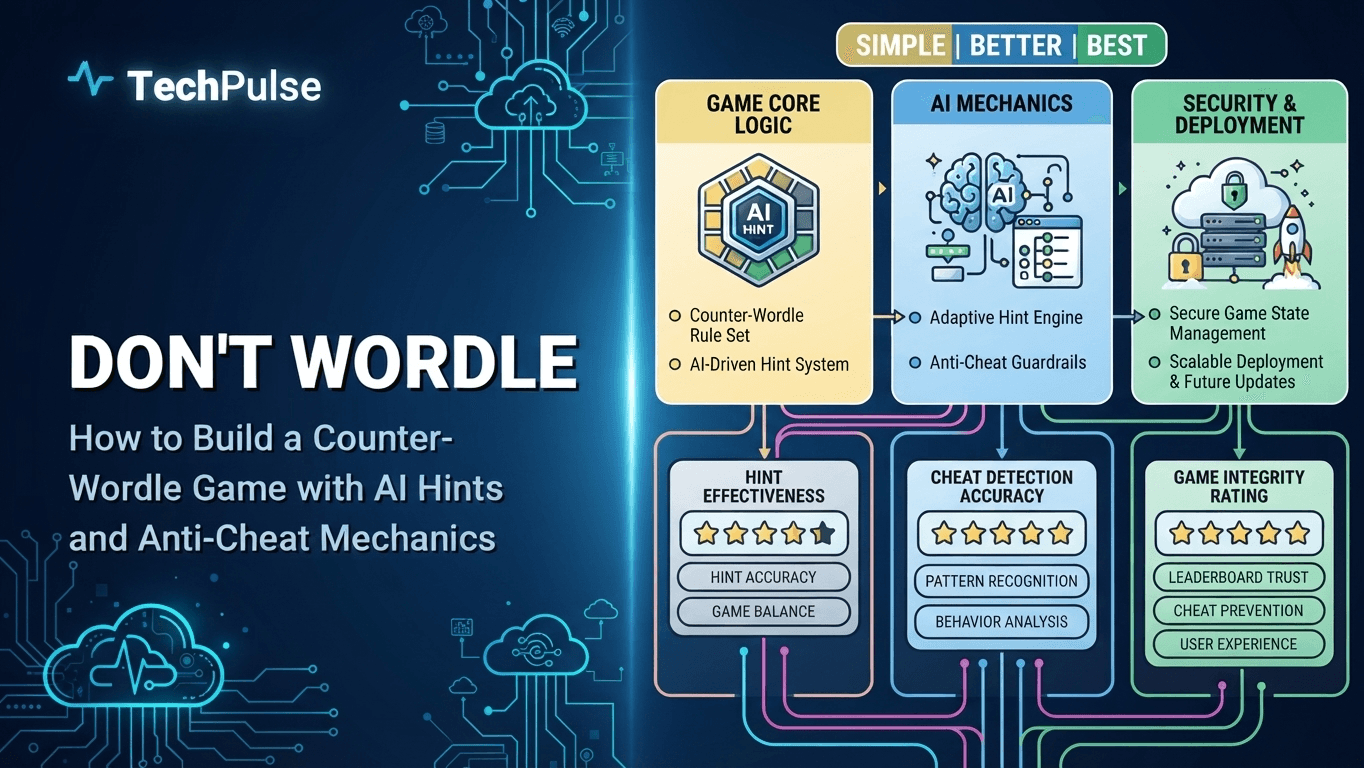
The 'Don't Wordle' framework showcases how traditional word‑puzzle mechanics can be reinvented with modern AI and anti‑cheat systems, delivering fresh engagement for both casual and competitive gamers.
By leveraging a React front‑end, a Node.js backend, and intelligent hint generation, developers gain a scalable architecture that can be extended to other reverse‑guess challenges or educational tools.
Ultimately, this project demonstrates the power of combining classic game design with cutting‑edge technology, offering a compelling case study for innovators seeking to disrupt familiar digital experiences.
TechPulse
Verified AuthorPrincipal Cloud Architect & AI Systems Engineer
Official editorial team and architectural research division at TechPulse, covering scalable web engineering, autonomous AI systems, and cloud infrastructure.
Stay Ahead of the Curve
Get our weekly digest of production blueprints, deep-dive benchmarks, and architectural audits delivered directly to your inbox.
Join 5,000+ engineers. No spam, ever.
You might also like
More deep dives for modern engineers.

Exploring GPT-6.1 SOL: Architecture, Capabilities, and Real-World Applications

Why the Boeing 787‑9 Dreamliner Was Diverted to LAX: Technical Causes & Operational Impact
